Computer Science & IT Semester Notes
Free, verified, chapter-by-chapter handwritten lecture notes, syllabus breakdowns, and high-speed PDF downloads for university students across BCA, B.Sc. CSIT, BE Computer, and BIT programs.
TU Semester SGPA & CGPA Calculator
Preloaded subjects for Semesters 1–8, credit hours, official TU 4.0 grading scale, and instant equivalent percentage & division classification.

Computer Networks (CN) Complete Study Notes
Covers OSI 7-Layer vs TCP/IP Models, IPv4 & IPv6 Subnetting, Routing Protocols (Distance Vector, OSPF, BGP), Error Detection CRC, CSMA/CD, and Transport Layer Sockets.
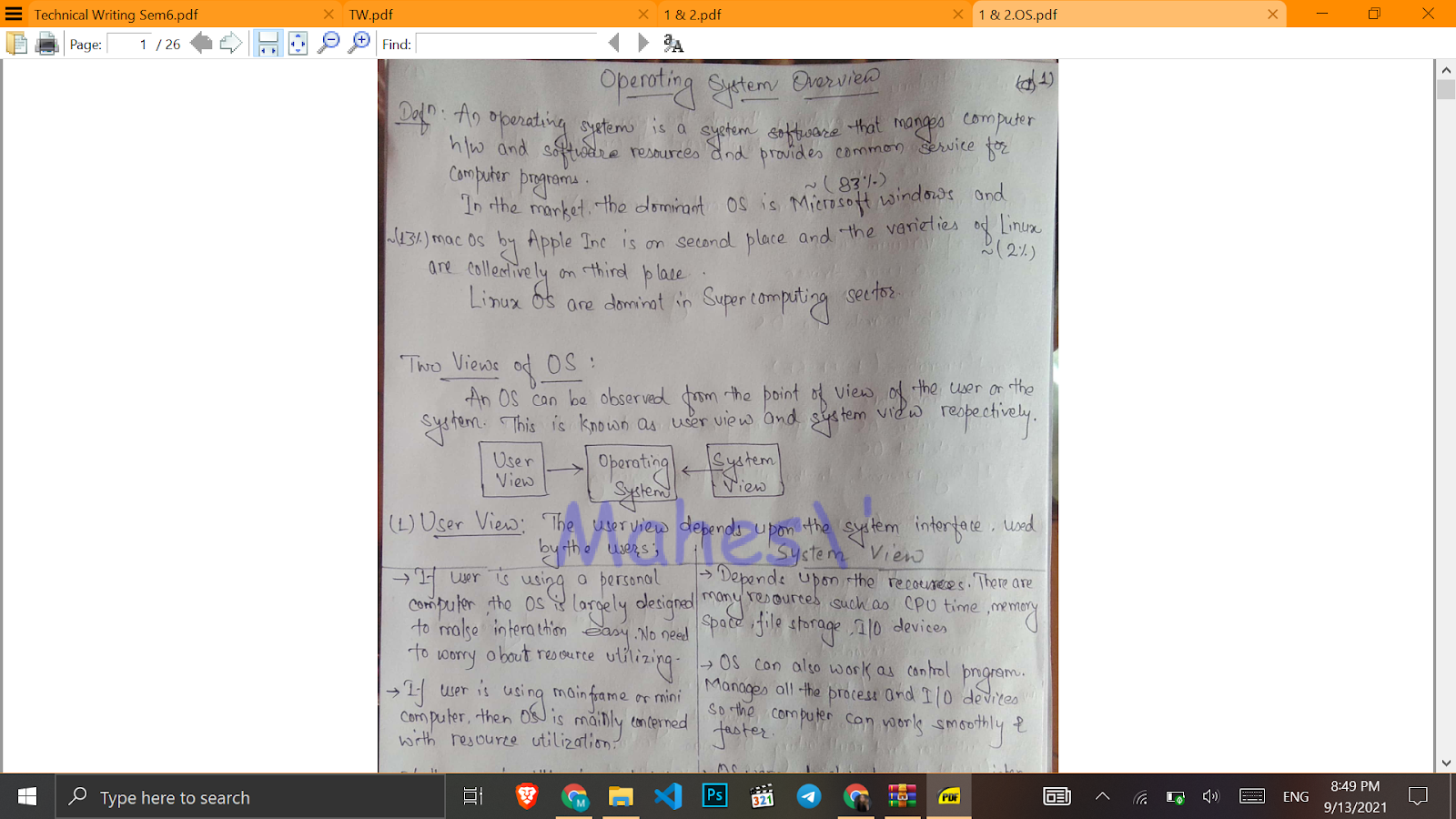
Operating System (OS) Complete Study Notes
In-depth coverage of Process Management, CPU Scheduling (FCFS, SJF, RR), Deadlocks & Banker's Algorithm, Paging, Segmentation, Page Replacement (LRU, Optimal), and Disk Scheduling.

Database Management System (DBMS) Notes
Master Relational Algebra, ER Diagrams, Normalization (1NF, 2NF, 3NF, BCNF), Complex SQL Joins, ACID Properties, Transaction Concurrency Control, and Two-Phase Locking (2PL).

Artificial Intelligence (AI) Complete Study Notes
Comprehensive guide covering Uninformed vs Informed Search (BFS, DFS, A* Algorithm), Minimax with Alpha-Beta Pruning, Knowledge Representation, Propositional & First-Order Logic.

Theory of Computation (TOC) Study Notes
Clear handwritten diagrams for DFA, NFA, epsilon-NFA, Regular Expressions, Pumping Lemma for Regular Languages, Context-Free Grammars (CFG), Pushdown Automata (PDA), and Turing Machines.

Mathematics-II (Calculus & Linear Algebra) Notes
Step-by-step solved derivations: Matrices, Determinants, Rank of Matrix, Eigenvalues & Eigenvectors, First & Second Order Differential Equations, Vector Spaces, and Partial Differentiation.

C++ Object-Oriented Programming (OOP) Notes
Complete theoretical principles and C++ code examples: Classes, Constructors, Operator Overloading, Inheritance Hierarchies, Virtual Functions & Polymorphism, Templates, and File Handling.
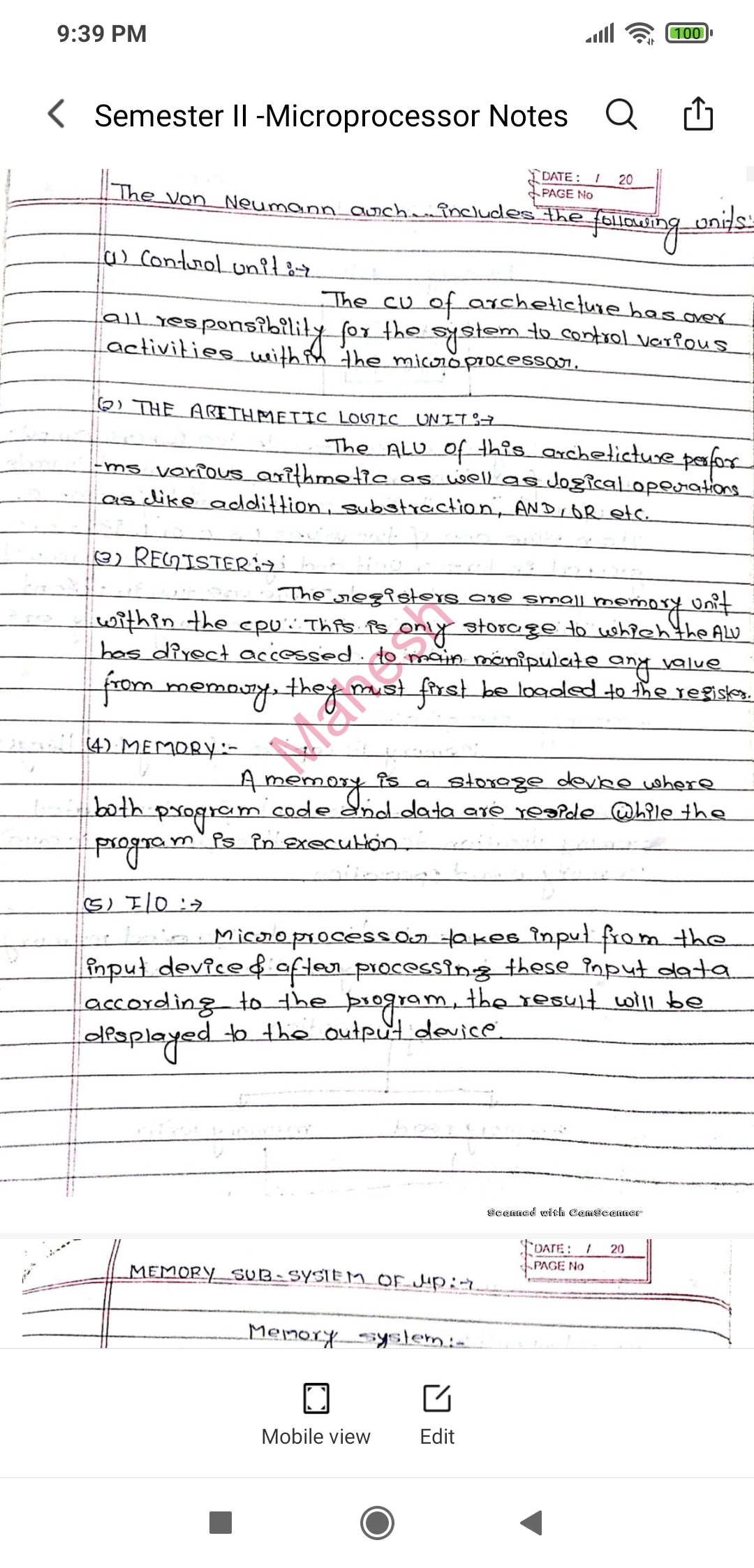
Microprocessor (8085 & 8086) Study Notes
Clear architecture diagrams, pinouts, 8085 instruction set & addressing modes, machine cycles, timing diagrams, memory interfacing, 8255 PPI, interrupts, and introduction to 8086.
TU Past Questions & Model Exam Papers
Curated chapter-wise weightage, recurring board exam questions, marks schemes, and reference model papers for TU BCA & B.Sc. CSIT semesters (2078–2081).
Computer Networks (CN) Exam Blueprint & Solutions
Question Scheme: Group A (10 × 1 = 10 Objective), Group B (6 × 5 = 30 Short Analytical), Group C (2 × 10 = 20 Long Practical / Subnetting).
• Differentiate between OSI 7-Layer and TCP/IP Reference Model with layer responsibilities.
• Given an IP address and CIDR prefix, design subnets and compute network/broadcast IDs.
• Explain CSMA/CD and CSMA/CA channel access protocols with flowcharts.
• Calculate CRC checksum for frame transmission with given generator polynomial.
Operating Systems (OS) Exam Blueprint & Solutions
Question Scheme: Group A (10 × 1 = 10 Objective), Group B (6 × 5 = 30 Short Analytical), Group C (2 × 10 = 20 Numerical / Algorithms).
• Banker's Algorithm deadlock avoidance numerical: compute Need Matrix & Safe Sequence.
• CPU Scheduling: Draw Gantt charts and compute average waiting time for Round Robin vs SJF.
• Critical Section Problem: Solve using Semaphores (Wait/Signal) and Peterson's Algorithm.
• Page replacement algorithms (FIFO, LRU, Optimal): compute page faults for given page reference string.
Database Management Systems (DBMS) Exam Blueprint & Solutions
Question Scheme: Group A (10 × 1 = 10 Objective), Group B (6 × 5 = 30 Short Theoretical), Group C (2 × 10 = 20 ERD / Normalization).
• Draw full E-R Diagram for a University/Hospital management system with cardinalities.
• Normalization numerical: Convert a relation with given Functional Dependencies from 1NF to BCNF.
• Write SQL queries using INNER/OUTER JOINs, GROUP BY, HAVING, and correlated subqueries.
• Explain ACID properties and conflict serializability using precedence graphs.
Theory of Computation (TOC) Exam Blueprint & Solutions
Question Scheme: Group A (10 × 1 = 10 Objective), Group B (6 × 5 = 30 Automata Constructions), Group C (2 × 10 = 20 TM / Grammar Proofs).
• Construct DFA to accept binary numbers divisible by 3 or strings ending with '01'.
• Convert NFA with ε-transitions to equivalent minimal DFA with transition tables.
• State and prove Pumping Lemma for Regular Languages; prove {0^n 1^n} is not regular.
• Design a Turing Machine (TM) with instantaneous descriptions that accepts {a^n b^n c^n | n ≥ 1}.
Artificial Intelligence (AI) Exam Blueprint & Solutions
Question Scheme: Group A (10 × 1 = 10 Objective), Group B (6 × 5 = 30 Short Heuristics), Group C (2 × 10 = 20 Logic / Search Trees).
• Explain A* Search algorithm with admissibility proof and solve 8-Puzzle problem.
• Minimax search with Alpha-Beta pruning: trace game tree and prune unvisited branches.
• Convert English statements into First-Order Predicate Logic (FOPL) and prove using Resolution.
• Compare Backpropagation Neural Networks with Expert Systems architecture and inference engines.
Object-Oriented Programming in C++ Exam Blueprint & Solutions
Question Scheme: Group A (10 × 1 = 10 Objective), Group B (6 × 5 = 30 Short Concepts), Group C (2 × 10 = 20 Code Implementations).
• Operator Overloading: Overload binary '+' and stream extraction '>>' operators using friend functions.
• Explain Virtual Functions, Pure Virtual Functions, and solve the Diamond Problem with Virtual Base Classes.
• Template Classes: Write generic Stack / Queue implementation with exception handling.
• Binary file operations in C++: write and read object records using fstream write() and read().
Microprocessor 8085 Exam Blueprint & Solutions
Question Scheme: Group A (10 × 1 = 10 Objective), Group B (6 × 5 = 30 Assembly/Hardware), Group C (2 × 10 = 20 Interfacing & Timing).
• Draw internal functional architecture block diagram of Intel 8085 with register organization.
• Memory Interfacing: Interface 4KB EPROM and 8KB RAM with 8085 using 74LS138 decoder.
• Draw timing diagrams for MVI A, 32H or LXI H instruction execution cycles (Opcode Fetch + Memory Read).
• Write 8085 Assembly Language Program (ALP) to sort an array of N numbers in ascending order.
Discrete Mathematics-II Exam Blueprint & Solutions
Question Scheme: Group A (10 × 1 = 10 Objective), Group B (6 × 5 = 30 Proofs & Graphs), Group C (2 × 10 = 20 Recurrence Relations).
• Solve second-order homogeneous linear recurrence relations: a_n = 5a_{n-1} - 6a_{n-2} with initial conditions.
• Graph Theory: Define Eulerian and Hamiltonian circuits; prove Kuratowski's theorem for planar graphs.
• Posets and Lattices: Draw Hasse diagram for divisibility on set D_36 and determine GLB / LUB.
• Mathematical Induction: Prove summation identities and divisibility proofs for all n ≥ 1.
🎓 Wondering how past paper marks convert into your final SGPA?
Simulate your target scores and grade points across all 5 semester subjects with our official TU 4.0 grading calculator.
How to Maximize Your Semester Exam Scores with These Notes
- ✓ Handwritten Conceptual Clarity: Diagrams and algorithms (such as Banker's Algorithm in OS, DFA conversions in TOC, and 8085 timing diagrams) should be practiced by hand on paper before exams.
- ✓ Chapter-by-Chapter Weightage: Focus heavily on topics carrying guaranteed 10-mark and 15-mark questions in past Tribhuvan University (TU) and Pokhara University (PU) board exams.
- ✓ Offline Access: Use the direct download buttons above to store high-resolution PDFs directly on your smartphone or tablet for uninterrupted study.