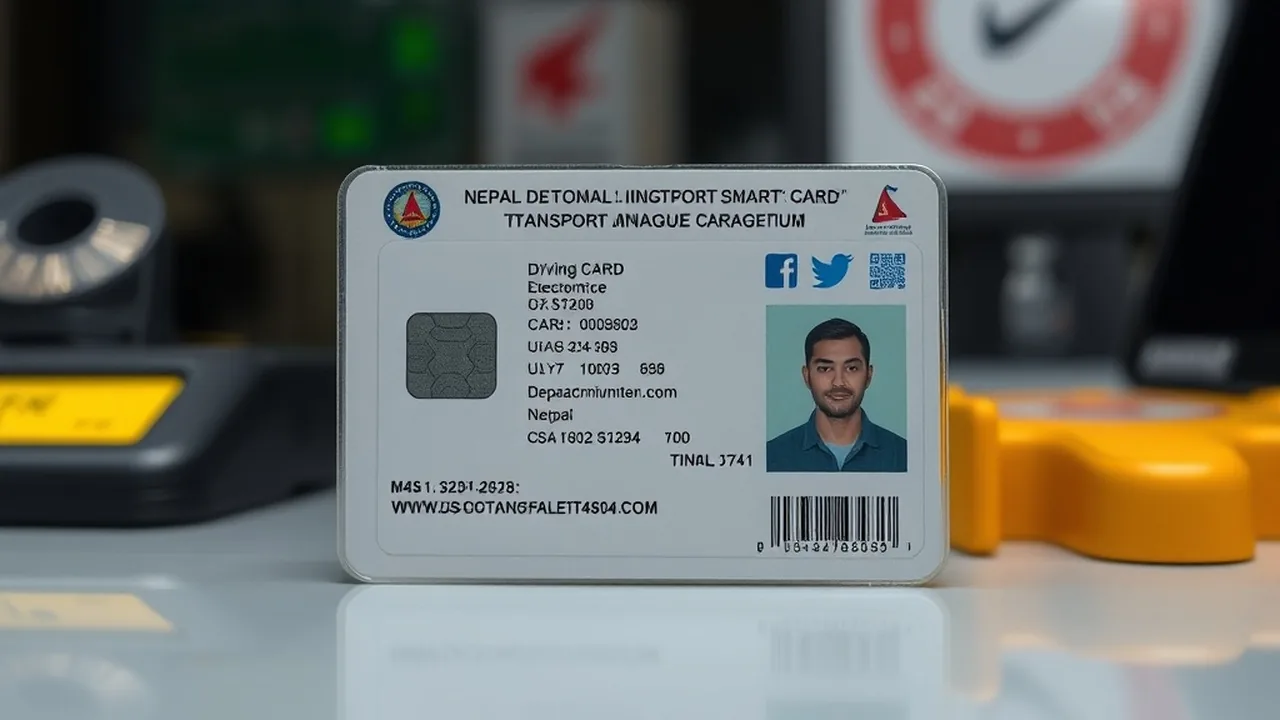
Obtaining an official Electronic Driving License (Smart Card) in Nepal through the Department of Transport Management (DOTM) requires navigating a multi-stage administrative and testing pipeline. Between quota allocation on the Electronic Driving License System (EDLS) portal, mandatory biometric verification, medical vision screening, computerized or paper-based written examinations, and practical trial maneuvers, procedural errors cause extended delays. Furthermore, with significant printing backlogs for physical smart cards, understanding temporary digital receipt validity and SMS status queries is essential. This operational guide provides an exhaustive breakdown of the entire 2026 DOTM licensing process for Category A (Motorcycle/Scooter) and Category B (Car/Jeep).
Nepal Driving License Pipeline Overview (2026)
1. Online Registration on the DOTM EDLRS Portal
The Department of Transport Management processes all fresh driving license applications exclusively through its modernized online portal (applydl.dotm.gov.np). Quotas open on daily scheduling cycles determined by provincial Transport Management Offices (Yayat Karyalaya):
- Account Creation & Mobile Verification: Enter your full legal name, date of birth (B.S. and A.D.), and an active Nepalese mobile number registered under your own citizenship. A dynamic OTP is sent via SMS to validate the session.
- Citizenship & Demographic Data: Enter your Citizenship Certificate number, district of issue, and issue date. Select permanent and temporary residential addresses matching official ward demarcation.
- Vehicle Category Selection: Choose Category A (Motorcycle, Scooter, Moped), Category B (Car, Jeep, Delivery Van), or commercial/heavy categories (C, D, E) if upgrading with prerequisite holding periods.
- Selecting Transport Office & Appointment Date: In the Kathmandu Valley, choose between Ekantakuna (Lalitpur), Radhe Radhe (Bhaktapur), Chabahil / Sukedhara, or Thulo Bharyang (Swayambhu). Outside the valley, select designated zonal offices (e.g., Pokhara, Butwal, Biratnagar, Nepalgunj).
- Downloading the Application Receipt: Upon successful submission, download and print the generated PDF application form containing your unique Applicant ID and QR barcode.
2. In-Person Biometrics, Document Verification & Medical Screening
On your scheduled appointment date, report to the chosen Transport Management Office during morning operational hours (10:00 AM – 1:30 PM). You must present physical original documents:
- Original Nepalese Citizenship Certificate plus two photocopies.
- Printed copy of the online application confirmation receipt with barcode.
- Blood group verification report or official donor card.
- Three passport-size photographs with clear white backgrounds.
Medical Fitness Screening: On-site medical officers conduct standard vision acuity checks using the Snellen chart (minimum 6/6 in one eye, 6/12 in the other), color blindness testing via Ishihara pseudoisochromatic plates (critical for distinguishing red/amber/green signals), and general physical mobility assessments. A medical fee of NPR 150 to NPR 200 is levied.
Digital Biometric Capture: Once cleared medically, applicants proceed to digital kiosks for live high-resolution facial portrait capture, digital signature recording on electronic pads, and 10-finger biometric fingerprint scanning.
Join NextByte Tech Community on Telegram
Get immediate notifications for new verified Windows fixes, open-source utilities, and tech tutorials.
3. Written Examination Structure & 500-Question Syllabus
The written examination tests foundational traffic regulations, road signs, vehicle mechanics, and defensive driving. Under revised provincial guidelines, the test comprises 20 multiple-choice questions drawn from DOTM's officially published 500-question repository:
| Topic / Domain | Question Count | Marks per Question | Core Focus Areas |
|---|---|---|---|
| Traffic Signs & Road Markings | 6 Questions | 5 Marks | Mandatory, cautionary, and informatory road signs |
| Right of Way & Junction Rules | 5 Questions | 5 Marks | Roundabout priorities, overtaking rules, zebra crossings |
| Vehicle Mechanics & Safety | 5 Questions | 5 Marks | Braking distance, dashboard warning lamps, tire pressure |
| Legal Penalties & Environmental Norms | 4 Questions | 5 Marks | Drunk driving (MaPaSe), pollution limits, fines |
The total exam carries 100 marks. In Bagmati Province, scoring 60 marks or above constitutes a passing grade (under the new point-based testing system). Results are announced on the same day via official notice boards or the office's official SMS portal.
4. Practical Trial Maneuvers: The 70-Point Assessment System
The practical driving examination assesses spatial awareness and vehicle control on a standardized obstacle course. Under the current 70-point threshold model, applicants do not automatically fail on a single minor infraction; instead, point deductions are tracked:
🏍️ Category A (Two-Wheeler Trial Course)
- The 8-Figure Maneuver: Navigating through the marked figure-8 without touching boundary lines (touching outer line once: -5 pts; foot touch once: -5 pts).
- Narrow Plank (Narrow Bridge): Riding across a straight narrow steel plank without stepping off or falling (falling off: instant disqualification).
- Traffic Light & Speed Bump: Stopping cleanly behind the stop line during red signals; engaging smooth clutch control over speed breakers.
- Uphill Gradient (Ramp): Stopping within marked yellow lines on an incline and restarting without rolling backwards more than 6 inches.
🚗 Category B (Four-Wheeler Trial Course)
- The 8-Shape Track: Driving forward through the 8-track without vehicle stalling or boundary curb contact.
- Traffic Signal Compliance: Stopping before the zebra crossing line when the traffic light turns red.
- Incline & Decline Ramp: Coming to a complete stop on the steep ramp, engaging handbrake, and resuming forward motion without stalling or rollback.
- Garage / L-Shape Reverse Parking: Reversing the vehicle smoothly into a confined rectangular bay without striking boundary flags or curbing.
5. Revenue Payment, Temporary Receipt & Smart Card Status Query
Upon passing the practical trial, the applicant must visit the Transport Management Office after 7 to 10 working days to clear final revenue fees (Rajaswa):
- Revenue Fees: NPR 1,500 for Category A; NPR 2,000 for Category B.
- Official Temporary Receipt (Rajaswa Rashid): The office issues a printed revenue receipt stamped with the licensee's license number, category, and date of issue. Under Nepalese law, this physical receipt is 100% legally recognized by Nepal Traffic Police as a valid temporary driving permit.
- Smart Card Print Tracking via SMS: Due to production backlogs, physical cards require 6 to 12 months for dispatch. To check your smart card print status, send an SMS from any NTC or Ncell SIM:
Example: LC 01-06-00123456 → Send to 31003
Response: Your Smart Driving License has been printed / Pending printing.
Explore Digital Nepal Solutions & Tools
Check out our verified guides on MDMS registration, National ID (NID), and international dollar cards in Nepal. 💳 Best Dollar Cards in Nepal 2026 →