
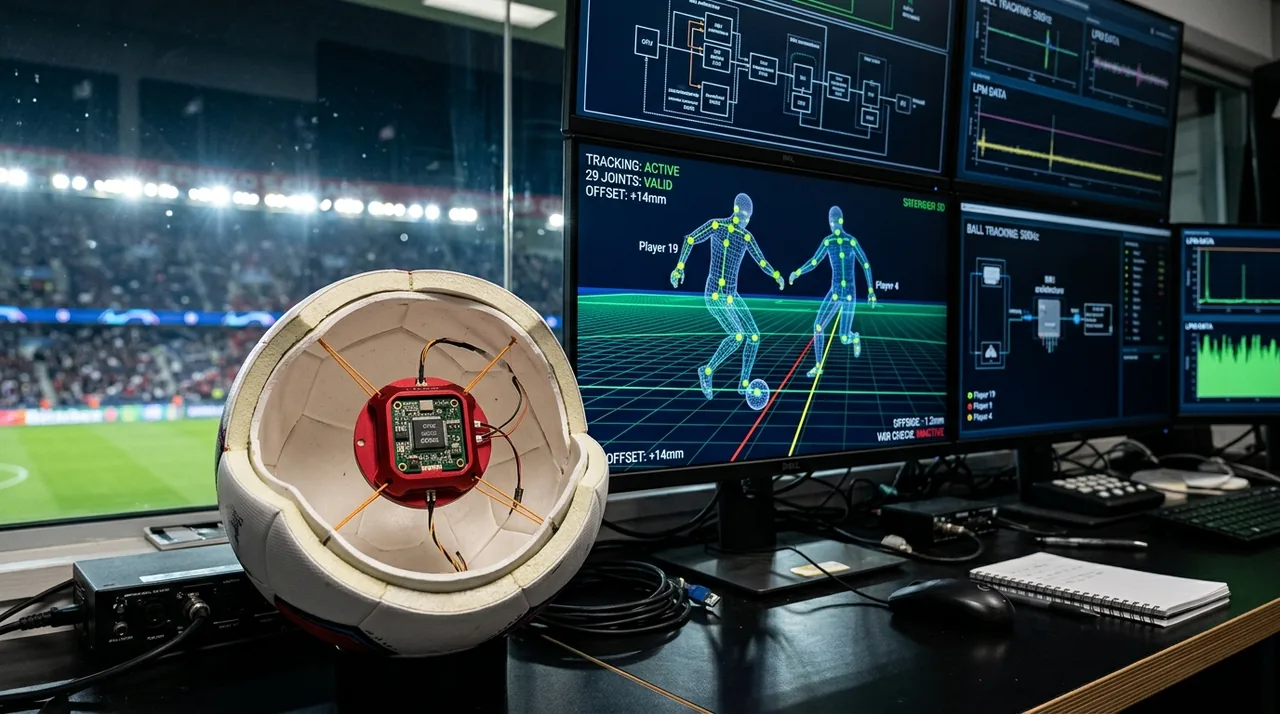
Few technological implementations in modern sports history have sparked as much controversy, debate, and engineering fascination as the Video Assistant Referee (VAR). For years, traditional VAR relied on broadcast operators manually scrubbing 50fps television footage, picking what appeared to be the exact contact frame, and drawing manual 2D perspective lines across warped camera angles. The result was agonizing five-minute game interruptions, parallax distortion errors, and widespread fan frustration. In 2026, premier football competitions—including the UEFA Champions League, FIFA tournaments, and top European domestic leagues—have transitioned to Semi-Automated Offside Technology (SAOT). By fusing 500Hz suspended inertial sensor telemetry with 12 synchronized optical tracking cameras running deep-learning skeletal estimation, SAOT resolves razor-thin offside calls within seconds. Here is the unvarnished engineering breakdown of how the hardware and computer vision algorithms operate.
1. The Connected Ball: Inside the 500Hz MEMS IMU Sensor
The foundational pillar of SAOT is establishing the precise millisecond the ball is kicked. In classical 50fps broadcast cameras, a single frame spans 20 milliseconds (ms). During that 20ms window, an elite sprinting winger like Vinícius Júnior or Kylian Mbappé moves approximately 18 to 22 centimeters—far exceeding the margin of a fractional offside call.
To solve the "point of contact" dilemma, modern match balls (such as Adidas Connected Ball technology) incorporate a specialized hardware sensor capsule suspended directly in the physical geometric center of the bladder:
| Hardware Component | Specification & Engineering Role | Performance Metric |
|---|---|---|
| MEMS Inertial Sensor | High-G 3-axis accelerometer paired with a 3-axis gyroscope | 500 Hz sampling rate (1 telemetry packet every 2.0 ms) |
| Suspension Mechanism | Ten high-tensile elastic cords anchored between outer bladder seams | Withstands 140 km/h shot impacts (>150G shock resistance) |
| Wireless Telemetry | Ultra-Wideband (UWB) transceiver broadcasting to pitchside receivers | Sub-10ms transmission latency; 12 pitchside receiver nodes |
| Power System | Rechargeable induction battery charged wirelessly on induction pedestals | Active battery lifespan of 6+ hours per full charge |
| Weight Impact | Central housing designed to eliminate rotational mass bias (wobble) | Total weight ~14 grams (imperceptible to players) |
Whenever a player's boot, head, or knee contacts the leather outer skin, the sudden acceleration spike registered by the central MEMS accelerometer is transmitted instantly over UWB. The edge computing engine detects the leading edge of the contact pulse, establishing the exact moment of ball release down to a 2ms window.
2. The Optical Array: 12 Synchronized 4K Tracking Cameras
While the ball sensor pinpoints when the pass occurred, optical cameras determine where every player's relevant body parts are positioned.
RAM Speed & True Latency Calculator
Calculate exact real response times in nanoseconds (ns) and dual-channel bandwidth for AMD Ryzen & Intel PC builds.
Stadium roofs are outfitted with 12 dedicated tracking cameras (primarily powered by Sony/Hawk-Eye or Second Spectrum). Unlike broadcast broadcast cameras that follow the ball dynamically, these 12 cameras are fixed in static, pre-calibrated positions around the catwalks, creating a continuous stereoscopic 360-degree volume of the playing pitch:
- 50 Hz Frame Synchronization: All 12 optical feeds are genlocked via PTP (Precision Time Protocol IEEE 1588) to a central master stadium clock, ensuring zero frame drift between opposite sides of the field.
- Sub-Millimeter Photogrammetry Calibration: Before each match, the pitch coordinates are calibrated using laser LiDAR tachymeters. The system maps pitch undulations, turf grade slopes, and camera lens thermal expansion factors into a precise 3D spatial matrix.
3. 29-Point Skeletal Mesh & Neural Pose Estimation
Raw video feeds alone cannot determine offside because an offside infraction depends strictly on body parts capable of legally scoring a goal (hands and arms are exempt under IFAB Law 11).
SAOT applies convolutional neural networks and transformer-based pose estimation models directly to the video streams. The neural network identifies and tracks 29 individual anatomical keypoints on every single player (22 outfield players plus match officials) 50 times every second:
- Head: Nose, Left Eye, Right Eye, Left Ear, Right Ear
- Torso: Left Shoulder, Right Shoulder, Center Neck, Sternum, Pelvis, Left Hip, Right Hip
- Upper Limbs (Exempt from offside lines): Left/Right Elbow, Left/Right Wrist, Left/Right Hand
- Lower Limbs (Offside critical): Left/Right Knee, Left/Right Ankle, Left/Right Heel, Left/Right Big Toe
# Offside Spatial Calculation Equation:
# Defending Line = Max_X(Valid_Keypoints(Defender_2nd_Last))
# Attacking Point = Max_X(Valid_Keypoints(Attacker_Target))
# Offset = Attacking Point - Defending Line (Positive = Offside)
By constructing a full 3D volumetric wireframe avatar of each player, the software automatically identifies the outermost offside-relevant extremity (for example, the cap of a defender's shoulder or the tip of an attacker's boot stud) without human operator intervention.
4. The Automated Alert & 3D Broadcast Rendering Pipeline
The true breakthrough of SAOT is the speed of its operational pipeline. Here is the sequential data flow that occurs during a contested goal:
- Kick Event Trigger: The ball's internal 500Hz sensor registers an impact peak. Telemetry packets timestamp the pass to 2026-10-01T19:42:15.842Z.
- Temporal Alignment: The edge server retrieves the exact genlocked optical video frames matching that 2ms timestamp from all 12 camera buffers.
- Volumetric Line Placement: The neural mesh computes the 3D positioning of the second-last defender and the targeted attacker. If the attacker's scoring limb is ahead of the defender's rearmost legal limb, the system flags an automated offside alert.
- VAR Operator Verification: The VAR booth does not draw manual lines; instead, they receive an automatically generated 3D visual snapshot. The human VAR referee simply verifies that the system tracked the correct attacker and defender, confirming the automated call within 15 to 25 seconds (down from 120–240 seconds in traditional VAR).
- Instant 3D TV Animation: Once confirmed, the 3D skeletal data is fed into a 3D rendering engine (such as Unreal Engine or specialized broadcast graphics processors) to generate the high-definition animated graphic shown to stadium big screens and millions of television viewers worldwide.
5. Real-World Limitations & The 2026 Technological Frontier
Despite dramatic improvements in speed and geometric accuracy, SAOT faces specific physical and algorithmic constraints that sports engineers continue to optimize:
- Occlusion Stacks: When multiple players collapse in a crowded penalty box during a corner kick, mutual body occlusion can momentarily hide a defender's heel from several cameras simultaneously. System redundancy requires multi-view triangulation algorithms to reconstruct occluded joints probabilistically.
- Interference & Subjective Offside: SAOT is strictly geometric. It cannot evaluate whether an attacker in an offside position was actively obstructing the goalkeeper's line of sight or challenging for the ball. Subjective infractions still require the on-field referee to review the pitchside monitor.
- Broadband Stadium Infrastructure: Deploying SAOT requires high-bandwidth local edge compute clusters capable of ingesting over 12 Gbps of uncompressed optical data and running multi-stream tensor inferences with zero reliance on cloud latency.
Summary: The Future of Spatial Computing in Global Sports
Semi-Automated Offside Technology exemplifies how edge computing, high-frequency MEMS hardware, and computer vision can solve long-standing human latency problems in high-stakes environments. As optical camera sensors advance toward 120fps 8K capture and on-device AI accelerators become more compact, sports analytics is evolving from retroactive slow-motion review into seamless, real-time spatial awareness.