
Fresh architectural documentation leaked from internal fabrication partners has unveiled AMD's next-generation desktop microprocessor lineup code-named "Medusa" (Zen 6). Scheduled for late 2026 tape-out and early 2027 retail launch, Zen 6 represents AMD's most radical structural overhaul since the inception of the chiplet design paradigm in 2019.
1. The 2nm Transition: TSMC N2 with GAAFET Nanosheets
The centerpiece of the Medusa architecture is the transition from FinFET transistors to TSMC's 2nm (N2) Gate-All-Around (GAAFET) nanosheet process. By wrapping the gate around all four sides of the channel, AMD achieves significant leakage reduction and superior power gating efficiency.
According to the leaked roadmaps, Zen 6 delivers:
- +18% IPC Uplift: Clock-for-clock instruction throughput gains driven by wider 8-wide decode engines and expanded execution schedulers.
- +25% Energy Efficiency: Identical computing performance delivered at one-quarter less package power draw compared to Zen 5.
- Max Boost Clocks Exceeding 6.2 GHz: Maintained on standard 360mm all-in-one liquid cooling loops without exotic sub-ambient refrigeration.
2. Massive 32-Core Single CCDs & 2.5D Interconnect Overhaul
In Zen 3 through Zen 5, AMD constrained its Core Complex Dies (CCDs) to 8 physical cores sharing a unified L3 cache slice. Medusa completely shatters this ceiling by introducing a high-density 32-core monolithic CCD for enterprise variants and a 16-core unified CCD for high-end consumer desktop SKUs (Ryzen 9 10950X).
Furthermore, AMD has retired the traditional substrate organic package traces in favor of an advanced 2.5D active interposer interconnect. By slashing core-to-core and CCD-to-IOD latency by 45%, cross-CCD gaming stutter—a historical quirk of multi-CCD Ryzen chips—is effectively eliminated.
RAM Speed & True Latency Calculator
Calculate exact real response times in nanoseconds (ns) and dual-channel bandwidth for AMD Ryzen & Intel PC builds.
3. Integrated RDNA 5 Graphics: Console-Tier Power on Die
While previous Ryzen desktop iGPUs were minimal 2-CU display adapters designed strictly for office troubleshooting, Medusa integrates a robust RDNA 5 microarchitecture compute block featuring up to 8 Workgroup Processors (16 CUs). Leaked synthetic 3DMark Time Spy benchmarks indicate performance rivaling dedicated mid-range graphics cards, capable of running modern esports titles at 1440p 120 FPS without an add-in PCIe GPU.
4. Memory Controller & DDR5-8000 Sweet Spot
Memory enthusiasts will welcome the redesigned Memory Controller (IMC). The revised I/O Die (IOD) supports native 1:1 FCLK gear mode up to DDR5-8000 MT/s, eliminating the latency penalties that plagued early Zen 4 and Zen 5 configurations.
⚡ Pro Hardware Tip for Builders
If you are assembling a gaming PC today, investing in an 8-layer PCB motherboard with high-spec memory traces (such as B650E or X870E) ensures seamless plug-and-play compatibility when drop-in Zen 6 upgrade BIOS files roll out. You can calculate exact power requirements for high-frequency builds using our PC PSU Bottleneck Calculator.
5. The Big Question: Is AM5 Socket Longevity Confirmed?
Yes. In confirmation of AMD's public roadmap commitment to support the AM5 ecosystem through 2027+, leaked electrical pinout manifests confirm that Zen 6 client processors remain 100% pin-compatible with LGA 1718 (Socket AM5). Existing motherboards based on A620, B650, X670, B850, and X870 chipsets will support Zen 6 processors via simple UEFI AGESA firmware updates.
6. Summary & Buying Advice for 2026 PC Builders
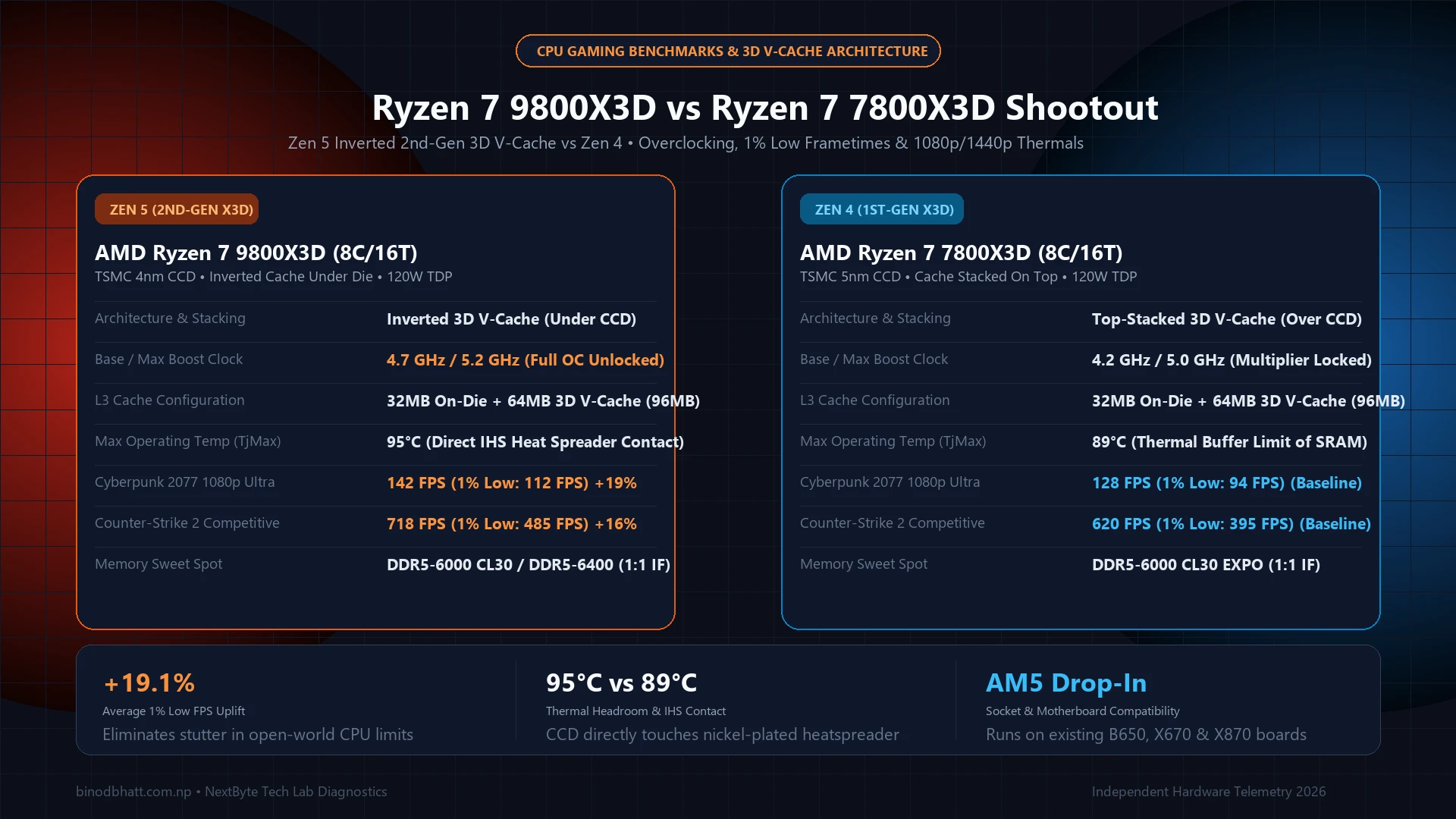
If you are currently running a Ryzen 7000 or older system, the upcoming Zen 6 generation will deliver a generational performance leap worthy of a complete platform refresh. For users already on Ryzen 9000 (such as the 9800X3D), your existing AM5 motherboard, cooling system, and DDR5 RAM will serve as a cost-effective drop-in upgrade path when Zen 6 debuts in retail channels.