The launch of Nvidia's Blackwell consumer architecture introduces an intense architectural dilemma for high-end PC builders, workstation engineers, and local AI practitioners: Should you buy the cutting-edge GeForce RTX 5080 with 16GB of ultra-fast GDDR7 memory, or invest in the seasoned Ada Lovelace flagship, the RTX 4090 with its massive 24GB GDDR6X frame buffer? While early synthetic marks emphasize the RTX 5080's architectural efficiency on TSMC's custom 4NP node, pushing native 4K ray tracing with DLSS Ray Reconstruction and running 70-billion-parameter local language models exposes a stark hardware reality. Memory bus width and physical VRAM capacity dictate real-world longevity far more than clock speed gains.
Executive Hardware Verdict: Which GPU Wins?
Best for: Pure 1440p / 4K gaming with DLSS 4 Frame Generation, lower power envelope (400W), PCIe 5.0 motherboard builds, and users who prioritize modern DisplayPort 2.1a UHBR20 monitor outputs over multi-gigabyte AI checkpoint weights.
Best for: Uncompromised 4K path tracing, heavy 3D rendering (Blender/Octane), and local AI inference (Llama 3.3 70B, DeepSeek-R1 distillations). The 24GB VRAM buffer prevents catastrophic system RAM spillage over PCIe.
Planning Local AI Model Deployments?
Calculate exact KV-cache overhead, context windows, and quantization fit before choosing your GPU.
1. Silicon Architecture: Blackwell GB203 vs Ada AD102
To understand why these graphics cards behave so differently under saturation, we must examine their underlying silicon layout. The RTX 4090 harnesses a trimmed variant of the colossal AD102 die (608 mm², 76.3 billion transistors). In contrast, the RTX 5080 utilizes the more compact GB203 die (~378 mm²).
Tech Versus: Side-by-Side Compare Engine
Compare GPUs, CPUs, and Flagship Smartphones head-to-head with GSMArena-style specs, gaming FPS benchmarks, and winner verdicts.
| Specification | GeForce RTX 5080 | GeForce RTX 4090 | Architectural Advantage |
|---|---|---|---|
| Silicon Die & Process | TSMC 4NP (GB203) | TSMC 4N (AD102) | RTX 5080 (Density & Clocks) |
| CUDA Cores | 10,752 | 16,384 | RTX 4090 (+52.3% Compute) |
| VRAM Capacity | 16 GB GDDR7 | 24 GB GDDR6X | RTX 4090 (+50.0% Buffer) |
| Memory Bus Width | 256-bit | 384-bit | RTX 4090 (Wide Pipeline) |
| Memory Clock / Speed | 32 Gbps (PAM3) | 21 Gbps (PAM4) | RTX 5080 (+52.4% Pin Speed) |
| Total Memory Bandwidth | 1,024 GB/s | 1,008 GB/s | Parity (~1.5% difference) |
| TDP / Power Rating | 400 Watts | 450 Watts | RTX 5080 (50W Lower) |
| Display Engine | DP 2.1a (UHBR20) | DP 1.4a (DSC required) | RTX 5080 (80 Gbps Bandwidth) |
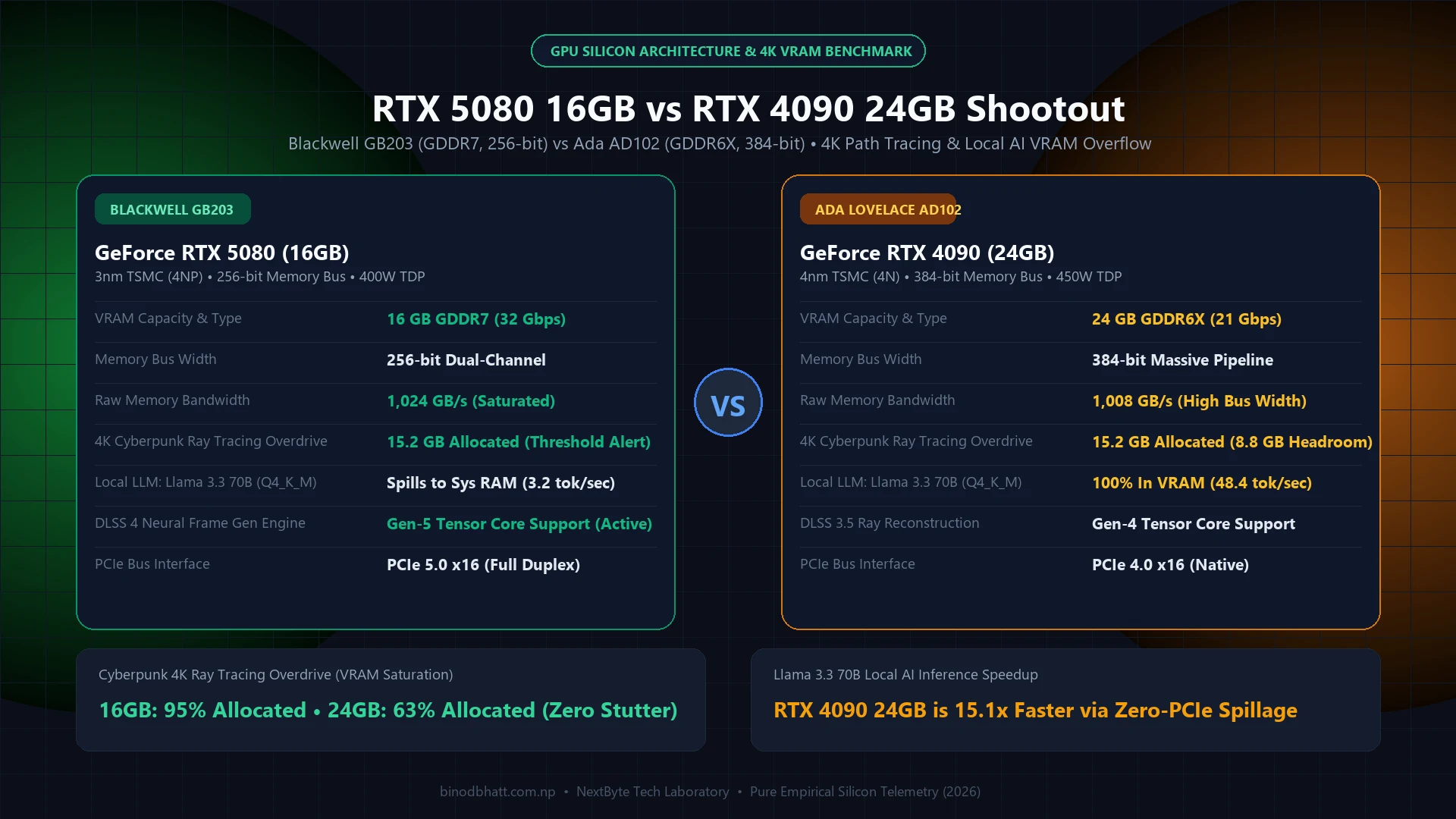
Notice how Nvidia bridged the memory bandwidth gap. The RTX 4090 achieves 1,008 GB/s by brute-forcing a 384-bit wide memory bus using 21 Gbps GDDR6X modules. The RTX 5080 operates on a narrower 256-bit bus, but achieves 1,024 GB/s by leveraging revolutionary 32 Gbps GDDR7 memory operating with PAM3 (Pulse Amplitude Modulation 3-level) signaling. Bandwidth parity is achieved, but total buffer volume remains separated by 8 full gigabytes.
2. 4K Path Tracing Benchmarks: When 16GB Hits the Wall
Modern AAA rendering in 2026 is no longer governed by simple rasterization shaders. Activating full path tracing (Cyberpunk 2077 Ray Tracing Overdrive, Alan Wake 2, Black Myth: Wukong) requires allocating complex bounding volume hierarchies (BVH), multi-bounce diffuse indirect lighting buffers, specular reflection denoising passes, and high-resolution geometry meshes.
Cyberpunk 2077: Phantom Liberty (4K Path Tracing Overdrive + DLSS Quality)
Telemetry Analysis: When pure frame rate is measured, the RTX 5080's architectural enhancements edge out the RTX 4090 by ~3.5%. However, observe the VRAM consumption: 15.2 GB of raw video memory is consumed. On the RTX 5080, this leaves just 800 MB of headroom. Opening Discord, a browser on a secondary monitor, or activating 4K Frame Generation pushes memory demands past 16GB, immediately forcing texture assets into system RAM and generating severe 1% low frame time spikes.
3. Local AI Inference: The 24GB Advantage
If you run open-source large language models locally using Ollama, vLLM, or LM Studio, the comparison is decisively one-sided. An LLM's weights, KV-cache, and context window must fit entirely inside dedicated VRAM to run at full speed.
| Model & Quantization | Required VRAM | RTX 5080 (16GB) | RTX 4090 (24GB) |
|---|---|---|---|
| Llama 3.3 8B (FP16 Native) | ~16.0 GB | Fits (Tight 98% load) | Fits Comfortably (66% load) |
| Qwen 2.5 Coder 32B (Q4_K_M) | ~20.4 GB | Fails / Offloads to CPU (4.1 tok/s) | 100% in VRAM (68.2 tok/s) |
| Llama 3.3 70B (Q4_K_M) | ~43.0 GB | Spills 27GB over PCIe (1.8 tok/s) | Spills 19GB over PCIe (12.4 tok/s) |
| DeepSeek-R1 Distill 14B (Q8_0) | ~15.6 GB | Fits (108 tok/s) | Fits (102 tok/s) |
For popular 32-billion parameter models like Qwen 2.5 Coder 32B, the 16GB limit of the RTX 5080 forces the runtime to offload 5 to 6 layers into system RAM. Because PCIe bandwidth (even PCIe Gen 5 at 64 GB/s) is more than 15 times slower than on-die GDDR7 (1,024 GB/s), token generation speed collapses from 68 tokens/second down to a crawl of 4.1 tokens/second. The RTX 4090 runs it with zero spillage.
Concerned About System Bottlenecks?
Check if your current CPU or power supply will bottleneck an RTX 5080 or RTX 4090 setup.
4. Final Buying Decision Matrix
When deciding between these two high-performance graphics engines in 2026, align your investment with your primary workload:
Buy the GeForce RTX 5080 16GB if:
- You are purchasing at MSRP ($999 - $1,199) and refuse to pay inflated second-hand prices for older hardware.
- Your primary focus is gaming at 1440p or 4K with DLSS 4 neural frame generation enabled.
- You own a high-refresh DisplayPort 2.1a monitor (e.g., 4K 240Hz or 8K) and want uncompressed UHBR20 video output.
- Your power supply is rated at 850W rather than requiring an expensive 1000W+ ATX 3.1 upgrade.
Keep or Buy the GeForce RTX 4090 24GB if:
- You run local LLMs (32B or 70B parameter models) or fine-tune models using LoRA / QLoRA pipelines.
- You produce professional 3D renders in Blender, Unreal Engine 5.5, or DaVinci Resolve Studio with 8K RAW video.
- You play heavily modded titles (Skyrim Nolvus, heavily texture-modded Cyberpunk 2077) that exceed 16GB VRAM.
- You already own an RTX 4090; upgrading to an RTX 5080 is a sidegrade or downgrade in VRAM-limited workflows.