
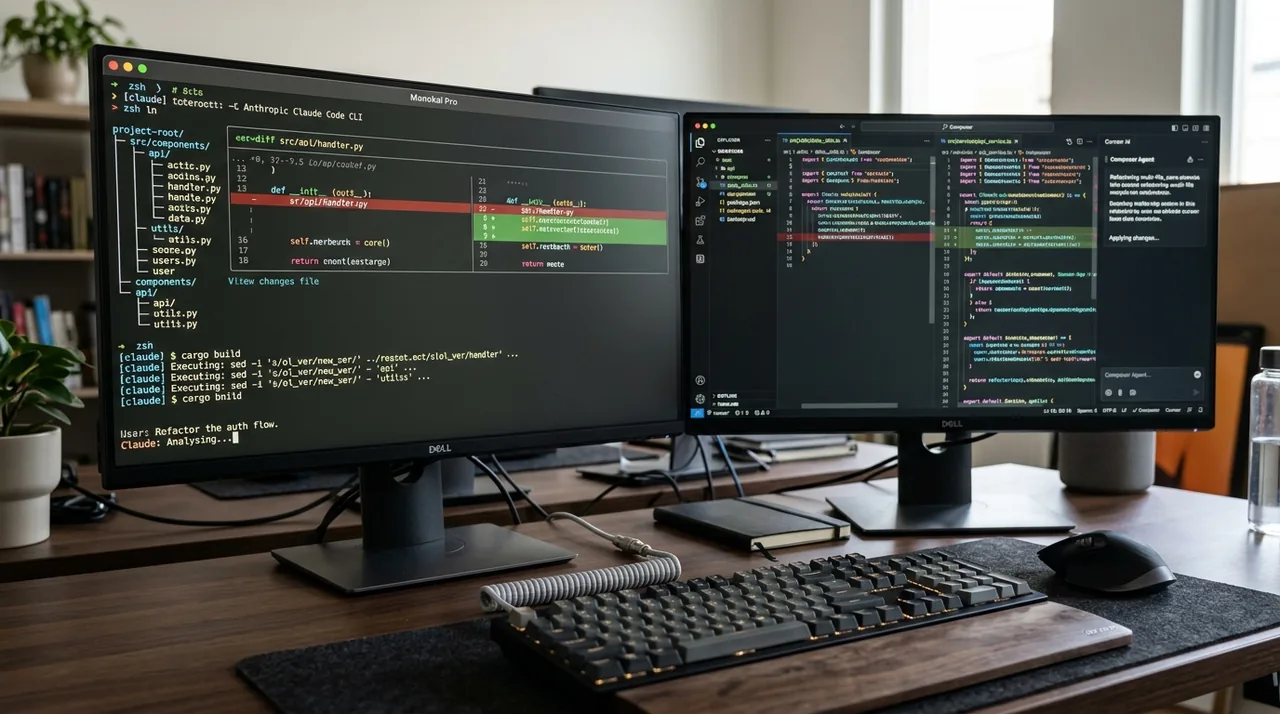
The software engineering workflow is undergoing its most aggressive architectural transformation since the adoption of Git. For the past two years, AI-assisted development was predominantly confined to IDE sidebars—first via tab-autocomplete copilots, and later through integrated agent panels like Cursor's Composer. With Anthropic releasing Claude Code, a standalone, terminal-native CLI agent designed to operate directly inside Unix shells, developers face a distinct choice: an all-in-one graphical IDE experience, or a lightweight, headless terminal agent that lives alongside your existing tmux, Neovim, or zsh workflows. In this comprehensive technical benchmark, we pit Claude Code against Cursor Agent across complex multi-file refactoring, Bash tool invocation, prompt caching token economics, and SWE-bench style repo debugging.
1. Architectural Paradigm: Terminal Daemon vs Electron IDE Host
To evaluate performance, one must understand how each tool interfaces with your codebase and developer environment:
| Feature Dimension | Anthropic Claude Code (CLI) | Cursor Agent (Composer) |
|---|---|---|
| Execution Runtime | Node.js / Native CLI executable directly in bash/zsh/fish | Electron-based VS Code fork with background LSP daemon |
| Primary LLM Engine | Claude 3.7 Sonnet / Claude 3.5 Sonnet (Direct Anthropic API) | Claude 3.7 Sonnet, GPT-4o, o3-mini (Cursor Proxied Backend) |
| Command Line Tool Use | Full native execution (can run cargo, pytest, npm, git directly) | Sandboxed terminal execution with modal permission prompts |
| Repository Indexing | Dynamic ripgrep, AST grep, and directory graph traversal on-demand | Local vector embeddings + Merkle tree codebase indexing |
| Editor Portability | 100% agnostic: works in Neovim, Helix, Zed, VS Code, SSH | Locked into Cursor IDE client application |
2. Multi-File Refactoring & Git Diff Precision
We tested both systems against a real-world TypeScript/Rust microservice codebase containing 84,000 lines of code across 140 files. The task: "Refactor the authentication token verification pipeline from RS256 JWTs to Ed25519 asymmetric signatures, update unit test suites, and fix any resulting compilation errors."
# Claude Code Workflow:
1. Uses ripgrep to find all imports of 'jsonwebtoken' and RS256 key paths (4 seconds).
2. Edits auth.ts, crypto.ts, and middleware.ts using precise unified diff blocks.
3. Automatically executes 'cargo test --lib' and 'npm test'.
4. Captures compiler error (mismatched curve parameter in test fixtures), edits fixtures.ts.
5. Runs 'npm test' again: 42/42 tests pass.
# Total Wall-Clock Time: 1m 48s | Human Interventions: 1 (permission to run test command)
# Cursor Agent Workflow:
1. Generates multi-file diff in visual Composer sidebar (12 seconds).
2. Requires manual review and clicking 'Accept' across each file block.
3. Launches integrated terminal to suggest running tests.
4. Compiler fails on fixtures; user must copy error back into Composer prompt.
# Total Wall-Clock Time: 3m 14s | Human Interventions: 5 (accept clicks + error reprompt)
Claude Code's tight feedback loop—inspecting errors directly through terminal STDOUT/STDERR and executing corrective actions autonomously—provides a substantial speed advantage in compiled languages where build failures are immediately actionable.
3. Token Economics: Prompt Caching vs Subscription Markup
Cost is a deciding factor for professional engineering teams. Large codebases quickly fill context windows, generating millions of input tokens per refactoring session:
Tech Versus: Side-by-Side Compare Engine
Compare GPUs, CPUs, and Flagship Smartphones head-to-head with GSMArena-style specs, gaming FPS benchmarks, and winner verdicts.
- Anthropic Prompt Caching: Claude Code leverages Anthropic's native prompt caching. Initial repository context is cached at $3.75/MTok for writes, while subsequent conversational turns read that cached prompt at just $0.375/MTok (a 90% discount). For a continuous 2-hour debugging session involving 20 million input tokens, the effective API cost totaled $11.40.
- Cursor Pro Pricing: Cursor charges a flat $20/month subscription providing 500 fast requests. However, once past the threshold, requests are throttled or billed on usage. For developers working 8 hours a day on multi-agent pipelines, Claude Code's direct pay-as-you-go API model prevents vendor lock-in and unpredictable throttling.
4. Safety, Shell Execution, and Guardrails
Granting an AI agent terminal command privileges introduces operational risk. Claude Code implements a strict interactive approval tier for destructive shell commands:
Claude wants to run:
> git reset --hard HEAD~1 && rm -rf target/debug/
Allow this action? [y/N/always for this session]:
Read-only operations (git status, cat, grep, find) execute silently to preserve speed, while write operations or git mutations require user confirmation. Cursor provides similar visual diff acceptance, but lacks fine-grained per-command Unix permission filters.
5. Final Verdict: Which Tool Should You Choose in 2026?
Choose Cursor if: You prefer visual inline code diffs, frequently rely on split-screen GUI debugging, enjoy VS Code's rich extension ecosystem, and prefer a predictable $20/month subscription model.
Choose Claude Code if: You are a terminal-first engineer (Neovim, tmux, SSH remote servers), require automated test-and-repair loops without manual copy-pasting, want direct API transparency with prompt caching, or work in headless CI/CD pipeline environments.