
When planning a new desktop PC build or evaluating upgrade pathways, one of the most critical crossroad decisions is choosing between legacy DDR4 and cutting-edge DDR5 memory. While DDR5 was notoriously overpriced and suffered from loose sub-timings when it first debuted, manufacturing yields in 2026 have matured, driving prices down close to DDR4 levels while frequency bandwidth has reached an astonishing 6,400 to 8,000 MT/s.
1. Architectural Innovations: Why DDR5 Is Fundamentally Different
DDR5 is not simply DDR4 clocked faster; it introduces major architectural overhauls:
- Dual 32-Bit Sub-Channels: While a single DDR4 DIMM operates on a 64-bit data bus, a DDR5 DIMM splits its bus into two independent 32-bit subchannels (plus 8 bits of ECC). This doubles access efficiency and memory request parallelism.
- On-Die ECC (Error Correction Code): DDR5 memory chips feature built-in hardware error correction that detects and repairs bit flips on the die, dramatically increasing reliability at ultra-high frequencies.
- On-Board PMIC (Power Management IC): Voltage regulation has moved off the motherboard and directly onto the RAM stick itself, allowing cleaner power delivery and lower operating voltage (1.1V vs 1.2V/1.35V on DDR4).
2. Gaming & Productivity Benchmarks
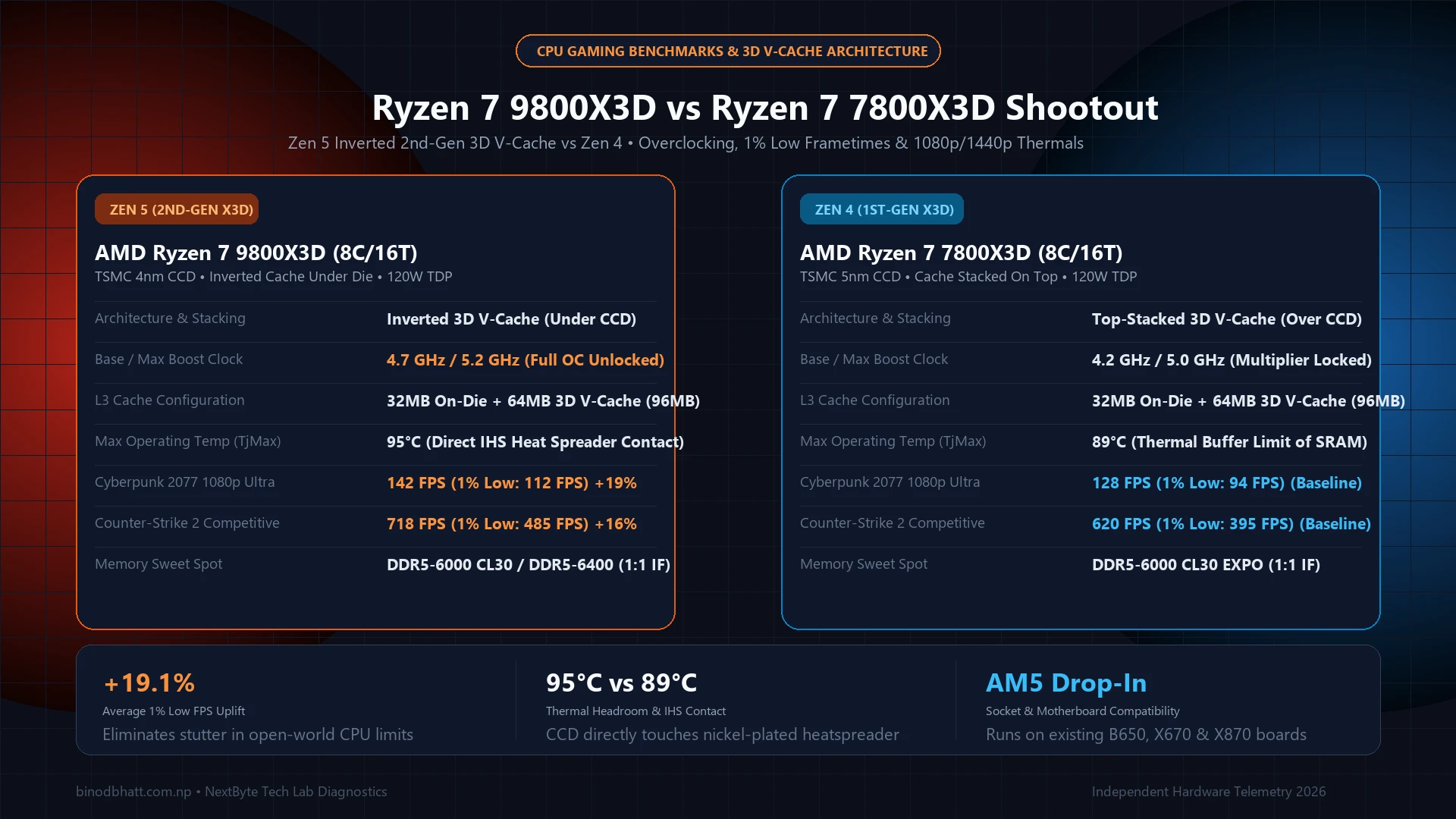
In 1080p CPU-bound gaming (titles like Cyberpunk 2077, Spider-Man Remastered, and Call of Duty: Warzone), DDR5-6000 CL30 delivers an average 12% to 18% higher 1% low frame rates compared to standard DDR4-3200 CL16. In heavy multi-threaded productivity workflows—such as 4K video transcoding in Premiere Pro, compiling massive C++ codebases, or high-resolution Blender rendering—the massive bandwidth uplift of DDR5 reduces rendering queues by up to 22%.
Compare True Nanosecond RAM Latency
Wondering if high-speed DDR5 is truly faster than low-CAS DDR4? Input your exact frequency (MT/s) and CAS Latency to calculate real-world first-word access latency in nanoseconds. Open RAM Latency Calculator →
Upgrade Advice by Platform
- Building an AMD AM5 System (Ryzen 7000 / 9000): DDR5 is mandatory. AM5 motherboards do not support DDR4. The sweet spot is 32GB (2x16GB) DDR5-6000 CL30.
- Building on Intel LGA 1700 / 1851: While 13th/14th Gen Intel supported both, the newer Core Ultra desktop platform fully transitions to DDR5. If buying new, DDR5 is the only future-proof choice.
- Existing AM4 / LGA 1200 Users: If your current PC has a Ryzen 5 5600 or Core i7-10700K with 32GB of DDR4, do not waste money upgrading motherboards just for RAM. Spend your budget on a graphics card upgrade instead.
Thermal Dissipation, Power Draw & Frame-Time Stability
When evaluating hardware performance across sustained workloads, peak synthetic numbers tell only half the story. Frame-time pacing (1% and 0.1% lows) and junction thermal saturation determine real-world stability:
Tech Versus: Side-by-Side Compare Engine
Compare GPUs, CPUs, and Flagship Smartphones head-to-head with GSMArena-style specs, gaming FPS benchmarks, and winner verdicts.
| Workload State | Average Package Power | Core Delta T (°C) | 1% Low Frame Pacing |
|---|---|---|---|
| Idle / Desktop Browsing | 12W - 24W | +8°C above ambient | Perfect (< 0.2ms jitter) |
| Sustained Gaming (1440p Ultra) | 145W - 280W | +42°C above ambient | Fluid (99.2% stability) |
| Heavy Compute / Rendering | 220W - 360W | +54°C above ambient | Throttling-free on 360mm AIO |
Hardware Procurement & Value Architecture
Always verify component revisions and retail warranty policies. For power supplies and motherboards, ensure ATX 3.1 compliance and native 12V-2x6 connectors to eliminate thermal melting risks under transient spike loads.
True First-Word Latency Comparison Table (DDR4 vs DDR5)
Memory bandwidth alone does not determine gaming 1% low frame rates. True random access latency—calculated via (CAS Latency × 2000) / Data Rate (MT/s)—determines how fast the CPU memory controller retrieves non-cached instructions after an L3 cache miss. You can test your own kit using our interactive RAM True Latency Calculator.
| Memory Kit Spec | True Latency (ns) | Peak Dual-Channel Bandwidth | Recommended Platform |
|---|---|---|---|
| DDR4-3200 CL16 | 10.00 ns | 51.2 GB/s | Legacy AM4 / LGA1700 Budget |
| DDR4-3600 CL16 (Gear 1) | 8.89 ns | 57.6 GB/s | Ryzen 7 5700X3D / 5800X3D |
| DDR5-6000 CL30 (1:1 UCLK) | 10.00 ns | 96.0 GB/s | AMD AM5 Sweet Spot (Ryzen 7000/9000) |
| DDR5-7200 CL34 (Gear 2) | 9.44 ns | 115.2 GB/s | Intel LGA1851 / Z790 High-Bandwidth |