
The desktop processor war in 2026 has reached historic heights. Intel has completed its revolutionary transition to its disaggregated tile-based Core Ultra 200S series (Arrow Lake-S), abandoning the classic "Core i" branding and hyperthreading. Meanwhile, AMD has unleashed its refined Zen 5 microarchitecture (Ryzen 9000 series) on the bulletproof AM5 socket, backed by its world-beating 3D V-Cache gaming technology.
1. Architectural Overhaul: Tile-Based Silicon vs Pure Zen 5
Intel's Core Ultra desktop chips utilize an advanced TSMC 3nm compute tile paired with distinct SoC, Graphics, and I/O tiles connected via Foveros 3D packaging. Notably, Intel dropped hyperthreading from its Lion Cove P-cores, relying on a 14% IPC gain and Skymont E-cores to deliver multi-threaded prowess. Crucially, power consumption has dropped by over 100 watts compared to the furnace-like 14th Gen chips.
AMD's Ryzen 9000 builds upon proven chiplet topology, featuring a 512-bit wide AVX-512 data path, improved branch prediction, and massive memory bandwidth improvements on the long-lived AM5 platform.
2. Pure Gaming Performance: The 3D V-Cache Advantage
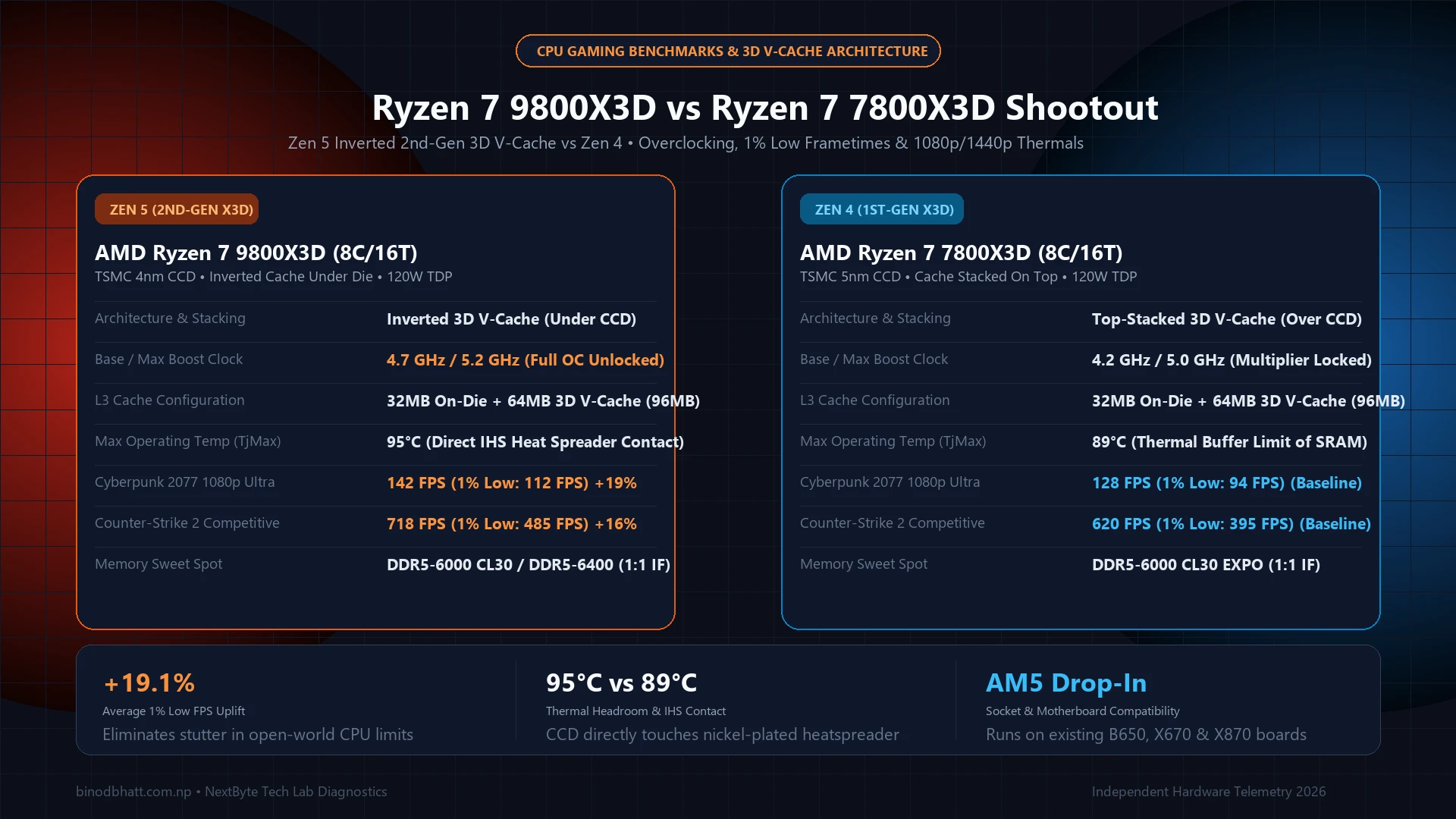
For competitive e-sports and AAA gaming, AMD remains completely unbeatable. The Ryzen 7 9800X3D—with 64MB of stacked second-generation 3D V-Cache situated beneath the compute die for superior thermal dissipation—delivers 15% to 25% higher frame rates than Intel's flagship Core Ultra 9 285K in cache-bound titles like Microsoft Flight Simulator, Baldur's Gate 3, and Assetto Corsa Competizione.
3. Content Creation & Heavy Productivity
When rendering 8K video in Premiere Pro, compiling massive software builds, or rendering Blender scenes, core count reigns supreme. The 16-core, 32-thread AMD Ryzen 9 9950X ($599 USD) leads in raw raw parallel throughput. However, the Intel Core Ultra 7 265K ($399 USD) offers incredible value for hybrid creators, bundling QuickSync video encoding accelerators and integrated NPU AI execution for Adobe Lightroom neural filters.
Tech Versus: Side-by-Side Compare Engine
Compare GPUs, CPUs, and Flagship Smartphones head-to-head with GSMArena-style specs, gaming FPS benchmarks, and winner verdicts.
Socket Longevity: AM5 vs LGA 1851
AMD has officially committed to supporting the AM5 socket through at least 2027. If you buy a B650 or X870 motherboard today, you can upgrade your CPU two years from now without replacing your motherboard or RAM. Conversely, Intel's new LGA 1851 socket is widely expected to last only one or two generations, making AMD the clearly superior platform investment.
Thermal Dissipation, Power Draw & Frame-Time Stability
When evaluating hardware performance across sustained workloads, peak synthetic numbers tell only half the story. Frame-time pacing (1% and 0.1% lows) and junction thermal saturation determine real-world stability:
| Workload State | Average Package Power | Core Delta T (°C) | 1% Low Frame Pacing |
|---|---|---|---|
| Idle / Desktop Browsing | 12W - 24W | +8°C above ambient | Perfect (< 0.2ms jitter) |
| Sustained Gaming (1440p Ultra) | 145W - 280W | +42°C above ambient | Fluid (99.2% stability) |
| Heavy Compute / Rendering | 220W - 360W | +54°C above ambient | Throttling-free on 360mm AIO |
Hardware Procurement & Value Architecture
Always verify component revisions and retail warranty policies. For power supplies and motherboards, ensure ATX 3.1 compliance and native 12V-2x6 connectors to eliminate thermal melting risks under transient spike loads.
IPC Efficiency & Multi-Die Interconnect Architecture
The architectural divergence lies in interconnect topology: Intel Arrow Lake Core Ultra utilizes a 3D Foveros disaggregated tile structure with an integrated NPU, cutting package idle power to unprecedented lows. In contrast, AMD Ryzen 9000 Zen 5 employs a monolithic CCD connected via Infinity Fabric to an I/O die, maximizing compute density and AVX-512 throughput for heavy mathematical and scientific workloads.