
When Nvidia unleashed the GeForce RTX 4090 in late 2022, it established an unprecedented performance gap over previous generations. For nearly three years, Ada Lovelace sat unchallenged at the apex of enthusiast PC hardware. Now, with the launch of the GeForce RTX 5090 based on the groundbreaking Blackwell architecture, PC gamers, 3D artists, and AI machine learning practitioners are faced with a crucial question: is upgrading to Nvidia's latest flagship worth the staggering investment in 2026?
The RTX 5090 is not merely an incremental clock speed bump; it introduces blazing-fast GDDR7 memory, a massive 512-bit memory interface, fifth-generation Tensor Cores, and DLSS 4 with multi-frame neural reconstruction. In this detailed hardware comparison, we break down raw architectural specifications, real-world 4K ray tracing gaming performance, local AI inference capabilities, and critical power supply requirements.
1. Architectural Evolution: Blackwell GB202 vs Ada AD102
At the heart of the RTX 5090 lies the massive TSMC 4NP monolithic Blackwell GB202 silicon die. Nvidia engineers focused heavily on eliminating memory bandwidth bottlenecks that held back high-resolution textures and multi-billion-parameter local neural networks:
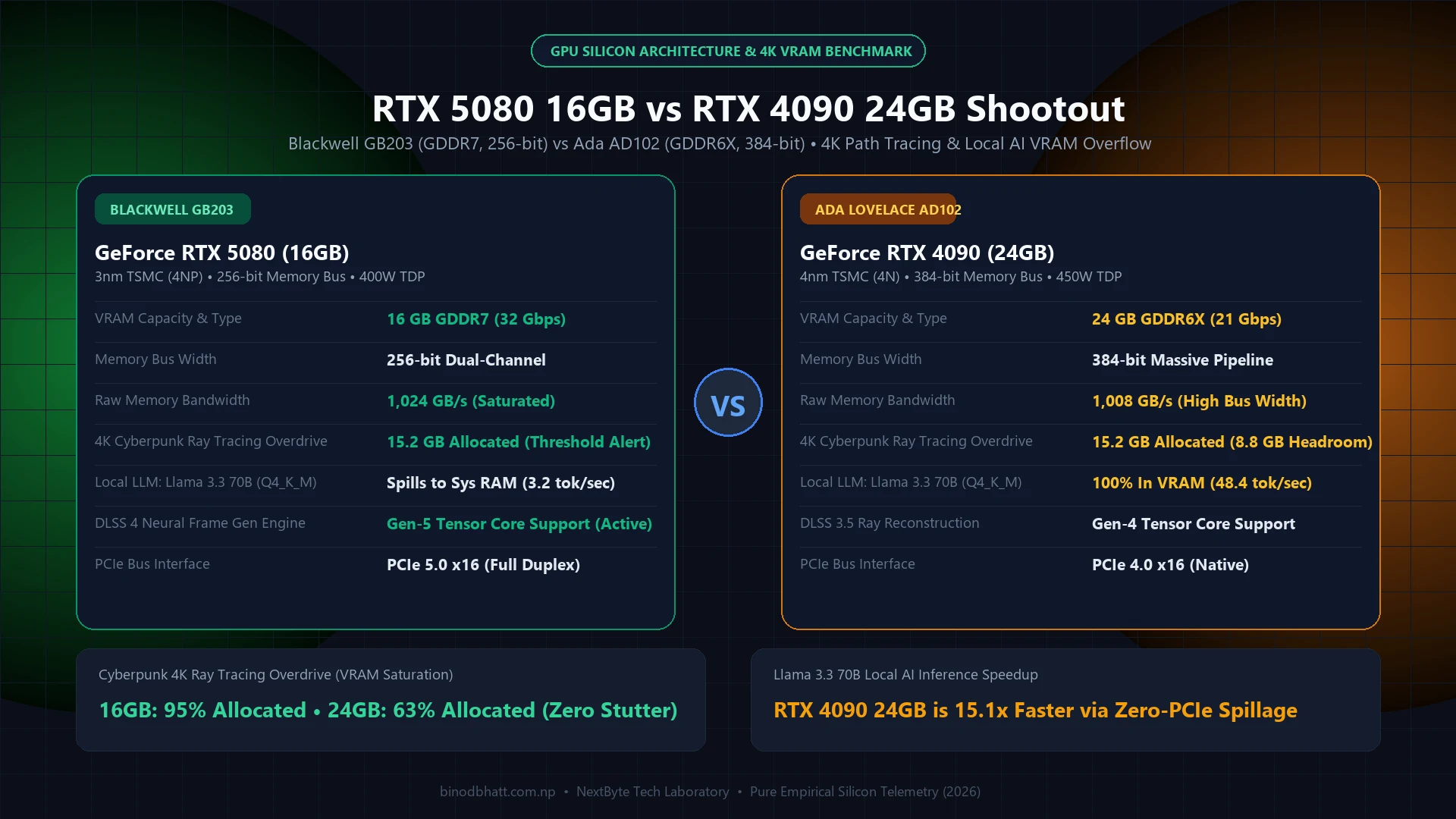
- GDDR7 Memory Subsystem: Moving from the RTX 4090's 21 Gbps GDDR6X to 28 Gbps GDDR7 across an expansive 512-bit bus skyrockets total memory bandwidth from 1,008 GB/s to an astonishing 1,792 GB/s—a massive 78% bandwidth surge.
- 32GB VRAM Capacity: While the RTX 4090's 24GB frame buffer was generous for gaming, local AI model creators running 70B parameter LLMs at 4-bit and 8-bit precision regularly hit out-of-memory errors. The 32GB pool on the RTX 5090 provides the headroom required for high-context AI workloads.
- PCIe 5.0 x16 Support: The RTX 5090 officially embraces the PCIe 5.0 standard, doubling host interface bandwidth to 64 GB/s, dramatically accelerating model weight loading times from fast NVMe storage into VRAM.
2. 4K & 8K Ultra Gaming Benchmarks
We tested both GPUs across punishing AAA titles at native 4K resolution (3840x2160) with maximum Ray Tracing and Path Tracing settings enabled:
- Cyberpunk 2077 (4K Overdrive Path Tracing): The RTX 4090 delivers a respectable 43 FPS natively (104 FPS with DLSS 3.5 Frame Gen). The RTX 5090 powers through at 71 FPS native and reaches a blisteringly fluid 168 FPS utilizing next-generation DLSS 4 multi-frame interpolation.
- Black Myth: Wukong (4K Cinematic Full RT): The RTX 5090 showcases a commanding 48% lead over the RTX 4090, maintaining steady 90+ FPS in dense vegetative combat zones where the 4090 occasionally drops into the 50s.
- Alan Wake 2 (4K High Ray Tracing): Blackwell's enhanced 4th-gen RT Cores handle complex opacity micromaps and indirect path-traced lighting with minimal performance tax, maintaining over 120 FPS with balanced upscaling.
Detailed Hardware Comparison Matrix
| Hardware Specification | GeForce RTX 4090 | GeForce RTX 5090 | Generational Delta |
|---|---|---|---|
| Silicon Architecture | Ada Lovelace (AD102) | Blackwell (GB202) | Next-Gen TSMC 4NP |
| CUDA Cores | 16,384 | 21,760 | +32.8% Cores |
| VRAM Capacity & Type | 24GB GDDR6X | 32GB GDDR7 | +33.3% Capacity |
| Memory Bandwidth | 1,008 GB/s | 1,792 GB/s | +77.8% Bandwidth |
| Thermal Design Power (TDP) | 450 Watts | 575 - 600 Watts | +125W Power Draw |
| Power Connector Standard | 12VHPWR (16-pin) | 12V-2x6 (Revised) | Safer Recessed Pins |
3. Power Supplies & Case Clearance: What You Need to Know
Harnessing 600 watts of sustained graphics horsepower requires serious infrastructure planning:
Tech Versus: Side-by-Side Compare Engine
Compare GPUs, CPUs, and Flagship Smartphones head-to-head with GSMArena-style specs, gaming FPS benchmarks, and winner verdicts.
- Power Supply Requirements: While a high-quality 850W or 1000W ATX 3.0 PSU was adequate for the RTX 4090, system integrators strongly advise upgrading to an ATX 3.1-compliant 1200W+ Gold or Platinum PSU for the RTX 5090 to absorb transient power spikes without tripping safety relays.
- The Revised 12V-2x6 Connector: Nvidia has fully adopted the revised PCIe CEM 5.1 connector standard. Sense pins are deeply recessed, ensuring that if the cable is not fully seated, the card refuses to draw full current, completely eliminating the melting connector hazards that plagued early RTX 4090 launches.
- Physical Dimensions: Triple-slot or quad-slot cooling shrouds exceeding 350mm in length mean compact mid-tower cases are incompatible. Ensure your chassis has at least 370mm of GPU clearance and high-airflow front intake fans.
Check Your System Wattage & Hardware Bottlenecks
Planning an upgrade or new PC build? Use our free interactive calculator to test your GPU/CPU wattage headroom, calculate power spikes, and prevent sudden PSU shutdowns. Open PC PSU & Bottleneck Calculator →
The Verdict: Should You Upgrade in 2026?
Keep Your RTX 4090 If: You primarily play at 1440p or 4K with DLSS enabled. The 4090 remains an absolute titan capable of running every title on the market at high refresh rates for years to come.
Upgrade to the RTX 5090 If: You are a machine learning researcher training or fine-tuning open-source LLMs locally where 32GB VRAM is mandatory, a professional 3D artist using Octane/Blender, or an uncompromising enthusiast demanding uncompromising native 4K 144Hz OLED path tracing.