
The high-end PC graphics market has entered a dramatic state of turbulence. In late September 2026, memory manufacturing titan Micron officially designated its first-generation 2GB GDDR7 modules as End-of-Life (EOL), triggering an acute supply squeeze for graphics cards across the industry. Concurrently, enterprise demand has caused flagship GPUs like the RTX 5090 to skyrocket past $10,000 on secondary markets.
In a swift strategic move to prevent consumer 16GB cards from running out of memory in upcoming titles, Nvidia has officially published RTX Mega Geometry 2.0 as part of the RTX Kit 2026.3 SDK. Designed to debut in upcoming blockbusters like Gears of War: E-Day, this technology fundamentally changes how virtual polygon meshes are buffered and rendered, slashing 4K VRAM consumption by up to 35%.
The GDDR7 Supply Crunch: What Actually Happened?
The transition to ultra-high-speed GDDR7 (reaching 28 to 32 Gbps PAM3 signaling) has encountered severe yield bottlenecks. Micron's departure from the 2GB module production line leaves Samsung and SK Hynix as the sole suppliers scrambling to meet demand for both consumer gaming GPUs and sovereign AI workstations.
The Memory Crunch Reality
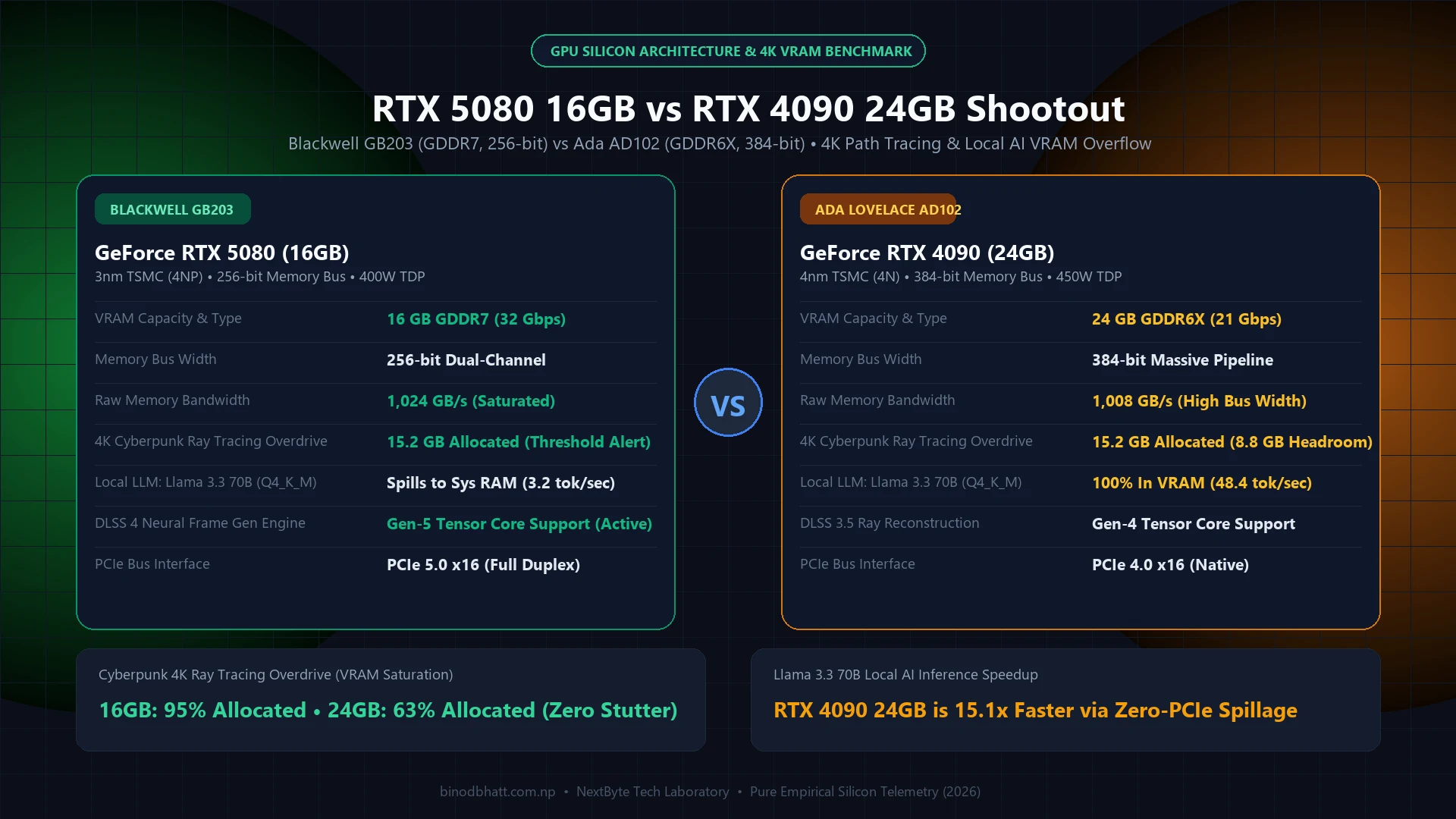
Because higher-density 3GB GDDR7 modules are not slated for mass volume delivery until late 2027, Nvidia and board partners cannot simply release 24GB or 32GB mid-range cards. As a result, 16GB remains the hard hardware ceiling for the RTX 5080 and 5070 Ti classes—making software-level VRAM optimization an urgent necessity rather than an optional luxury.
Under the Hood: How RTX Mega Geometry 2.0 Works
In standard graphics pipelines, game engines load massive uncompressed geometry vertex buffers (position, normal vectors, tangent spaces, UV coordinates) for millions of triangles into VRAM. Even when an object is hundreds of meters away in the background, high-poly geometry continues to occupy expensive video memory.
RAM Speed & True Latency Calculator
Calculate exact real response times in nanoseconds (ns) and dual-channel bandwidth for AMD Ryzen & Intel PC builds.
RTX Mega Geometry 2.0 introduces a low-level hardware abstraction layer that mirrors the principles of virtual texturing directly to 3D geometry:
- Continuous Meshlet Streaming: Instead of loading monolithic 3D meshes, geometry is sliced into lightweight "meshlets" of 64 to 128 vertices. The GPU driver dynamically streams only the visible front-facing mesh clusters into GPU cache on a per-frame basis.
- Hardware Sub-D Displacement: Coarse low-poly base geometry is stored in VRAM. High-frequency micro-details (cracks in concrete, wrinkles in clothing, intricate foliage) are tessellated and synthesized algorithmically in on-chip L2 cache during the primitive shader pass.
- Coordinated Ray Tracing BVH Compression: By computing Bounding Volume Hierarchy trees directly on active visible mesh clusters rather than the entire static world, memory allocated for Ray Tracing BVH structures is reduced by nearly half.
Real-World 4K Memory Savings: Before & After
Early benchmark metrics released from developer builds of Gears of War: E-Day and custom Unreal Engine 5.5 test scenes show dramatic reductions in memory pressure:
| 4K Scene Scenario | Legacy Pipeline VRAM | RTX Mega Geometry 2.0 | Net Memory Reclaimed |
|---|---|---|---|
| Dense Urban Ruin (Nanite Foliage + Debris) | 16.4 GB (Over Limit) | 10.9 GB (Safe) | -5.5 GB (-33.5%) |
| Cinematic Character Close-Up (Full Path Tracing) | 14.8 GB | 9.8 GB | -5.0 GB (-33.7%) |
| Open Landscape Battle (High Draw Distance) | 17.1 GB (PCIe Spill) | 11.4 GB | -5.7 GB (-33.3%) |
What This Means for 12GB & 16GB GPU Owners
For gamers who purchased graphics cards like the RTX 4070 (12GB), RTX 4070 Ti Super (16GB), or are eyeing the RTX 5080 (16GB), RTX Mega Geometry 2.0 is a massive lifeline. It effectively postpones the "VRAM wall" where games were beginning to stutter due to PCIe memory swapping.
However, this feature requires developer implementation via the latest DirectX 12 Agility SDK and Vulkan extensions. While flagship upcoming titles will support it natively, older unpatched games will still demand raw physical VRAM capacity.
Want to see whether your current GPU and CPU combination will experience memory or throughput limits? Test your configuration on our free PC Gaming Bottleneck & FPS Calculator 2026.