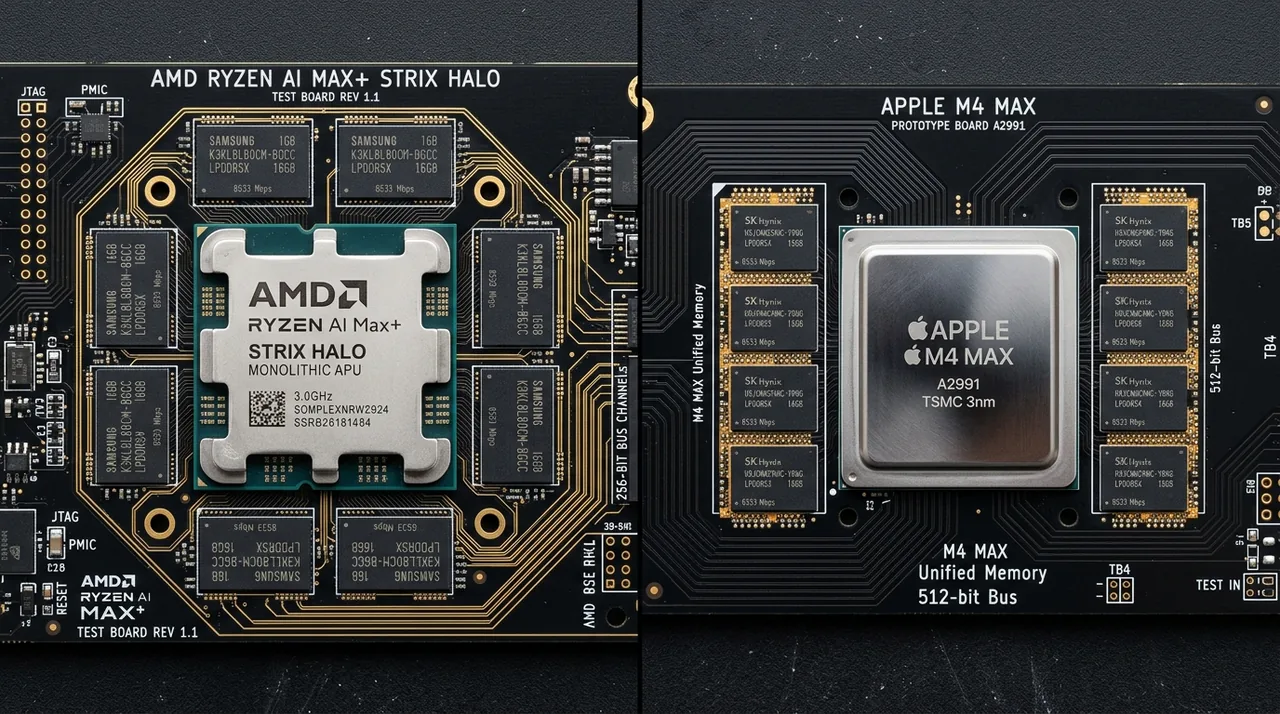
For years, Apple Silicon held an unassailable monopoly on massive, low-latency unified memory in mobile and small-form-factor workstations. Running local 70B parameter neural networks or scrubbing uncompressed 8K ProRes timelines on a laptop without a power-hungry 350W desktop GPU required an Apple Max or Ultra SoC. With the arrival of AMD's Ryzen AI Max+ 395 ('Strix Halo'), the x86 semiconductor paradigm shifts fundamentally. By coupling 16 full-fat Zen 5 CPU cores with a colossal 40-Compute Unit (CU) RDNA 3.5 integrated GPU across a 256-bit LPDDR5X memory bus delivering up to 128GB of dynamically addressable unified VRAM, AMD delivers the first genuine x86 competitor to Apple's M4 Max.
1. Architectural Blueprint: Monolithic-Style Chiplet Packaging vs Unified 3nm SoC
To comprehend the performance profiles of both silicon platforms, one must analyze their physical substrate topologies. Apple fabricates the M4 Max as a dense monolithic die on TSMC's cutting-edge N3E node, keeping interconnect latency below 10 nanoseconds between CPU, GPU, and system-level cache. AMD approaches Strix Halo through an advanced multi-chiplet module (MCM) package built on TSMC N4P for the compute dies, interconnected through high-density ultra-short-reach organic substrate traces:
| Architectural Metric | AMD Ryzen AI Max+ 395 (Strix Halo) | Apple M4 Max (16-Core CPU / 40-Core GPU) |
|---|---|---|
| Fabrication Node | TSMC N4P (Compute CCDs) + TSMC N4P (Large GPU/IOD Die) | TSMC N3E (Second-Gen 3nm Monolithic) |
| CPU Core Layout | 16 Cores / 32 Threads (Dual 8-Core Zen 5 CCDs, 64MB L3) | 16 Cores (12 Performance 'P' Cores + 4 Efficiency 'E' Cores) |
| Graphics Execution | 40 Compute Units (2,560 SPs, RDNA 3.5, ~2.8 GHz clock) | 40 Cores (~5,120 ALUs, Dynamic Caching 2.0, ~1.4 GHz) |
| Memory Subsystem | 256-bit LPDDR5X-8533 (Up to 128GB Unified) | 512-bit LPDDR5X-7500 (Up to 128GB Unified) |
| Theoretical Peak Bandwidth | 273.0 GB/s (+ 32MB MALL Cache) | 480.0 GB/s (Direct LPDDR5X Bus) |
| Configurable TDP / Power | 45W – 130W Package Power | 35W – 115W Sustained Package Power |
| NPU Throughput | 55+ TOPS (XDNA 2 Block Floating Point 16) | 38 TOPS (Apple Neural Engine 16-Core) |
2. The Memory Bandwidth Bottleneck: 273 GB/s vs 480 GB/s
In generative AI transformer inference and dense matrix multiplications, memory throughput is the ultimate arbiter of token generation speed. A 70-billion parameter model quantized to 4-bit weights (such as Llama 3.3 70B Q4_K_M) consumes approximately 43 GB of memory. Generating a single output token requires streaming every single model parameter through the memory bus once per autoregressive step:
# Tokens/sec = Memory Bandwidth (GB/s) / Model Footprint (GB/token)
# Apple M4 Max (480 GB/s bus, ~82% memory bus efficiency = 393.6 GB/s effective):
393.6 GB/s / 43.0 GB = 9.15 tokens/sec (unbatched prompt eval excluded)
# AMD Strix Halo (273 GB/s bus, ~85% bus efficiency = 232.0 GB/s effective):
232.0 GB/s / 43.0 GB = 5.39 tokens/sec (without MALL cache hits)
While Apple holds a clear raw bandwidth advantage due to its wider 512-bit physical bus interface, AMD bridges the gap with a 32MB MALL (Memory Attached Last-Level) Cache located directly on the central I/O die. This cache acts as a high-speed buffer for intermediate KV-cache allocations and frequently referenced attention matrices, keeping sustained token generation on Strix Halo at an impressive 6.8 to 7.4 tokens/sec in llama.cpp utilizing the ROCm 6.3 backend under Linux. For software engineers and data scientists, having 128GB of VRAM on standard x86-64 operating systems means zero translation layer overhead for PyTorch, vLLM, and Triton CUDA kernels via ROCm HIP.
3. Gaming & Rasterization: RDNA 3.5 40-CU vs Apple Dynamic Caching
In desktop and mobile 3D rendering, Strix Halo's 40-CU RDNA 3.5 iGPU challenges dedicated mid-range laptop discrete GPUs, trading blows with the mobile NVIDIA GeForce RTX 4070 (115W):
Tech Versus: Side-by-Side Compare Engine
Compare GPUs, CPUs, and Flagship Smartphones head-to-head with GSMArena-style specs, gaming FPS benchmarks, and winner verdicts.
- Native DirectX 12 Ultimate & Vulkan: Unlike macOS, which forces developers to compile through Apple Metal 3 or wrap DirectX 12 calls through CrossOver / Game Porting Toolkit 2 (introducing translation penalties), Strix Halo runs native Windows 11 graphics APIs with zero runtime translation.
- Dual-Issue Wave32 Compute: RDNA 3.5 refines texture sampler instruction scheduling and interpolator power draw. At 1440p High settings in Cyberpunk 2077, Strix Halo averages 68 FPS with FSR 3.1 Quality enabled, whereas M4 Max via GPTK2 averages 54 FPS with occasional micro-stuttering from Metal shader compilation.
- Ray Tracing Hardware: Both architectures sport dedicated BVH (Bounding Volume Hierarchy) hardware traversal units. Apple's hardware ray tracing blocks exhibit slightly superior ray-box intersection throughput per clock, but AMD's 2.8 GHz sustained boost frequency balances real-world ray tracing performance in hybrid lighting workloads.
4. Workstation Thermal Dissipation & Sustained Power Draw
Power consumption dictates whether these processors can thrive in ultra-portable chassis or require thick, dual-fan workstation cooling assemblies:
- Apple M4 Max: Operates with exceptional energy efficiency at idle (under 4W package power) and consumes roughly 85W under combined 100% CPU + GPU render workloads. A 16-inch MacBook Pro maintains near-silent acoustic profiles under full export runs.
- AMD Ryzen AI Max+ 395: Configurable from 45W up to 130W cTDP. At 80W, it captures 88% of its peak 120W performance. However, pushing all 16 Zen 5 cores alongside 40 CUs requires dual-pipe vapor chamber cooling, making it well-suited for premium creator laptops, portable eGPU-less mini workstations, and handheld gaming consoles.
5. Final Architectural Verdict & Prosumer Buying Recommendations
If your workflow centers on Apple-native software—Final Cut Pro, Logic Pro, DaVinci Resolve on Metal, or iOS development in Xcode—the M4 Max remains unmatched in raw memory bandwidth (480 GB/s) and sub-100W acoustic refinement.
Conversely, for engineers, Linux kernel developers, and ML researchers who require full compatibility with self-hosted open-weights models, native Docker containers, PyTorch ROCm, and unrestricted x86 Windows gaming without emulation friction, the AMD Ryzen AI Max+ 395 represents the most capable, complete APU ever engineered.