For the past four years, desktop DDR5 memory scaling has wrestled with an unforgiving physical constraint: high-frequency signal integrity. As memory frequencies pushed past DDR5-7200 on unbuffered DIMMs (UDIMMs), clock jitter and capacitive trace load across motherboard PCB layers made stable boot cycles nearly impossible without silicon lottery memory controllers (IMCs) and extreme voltages.
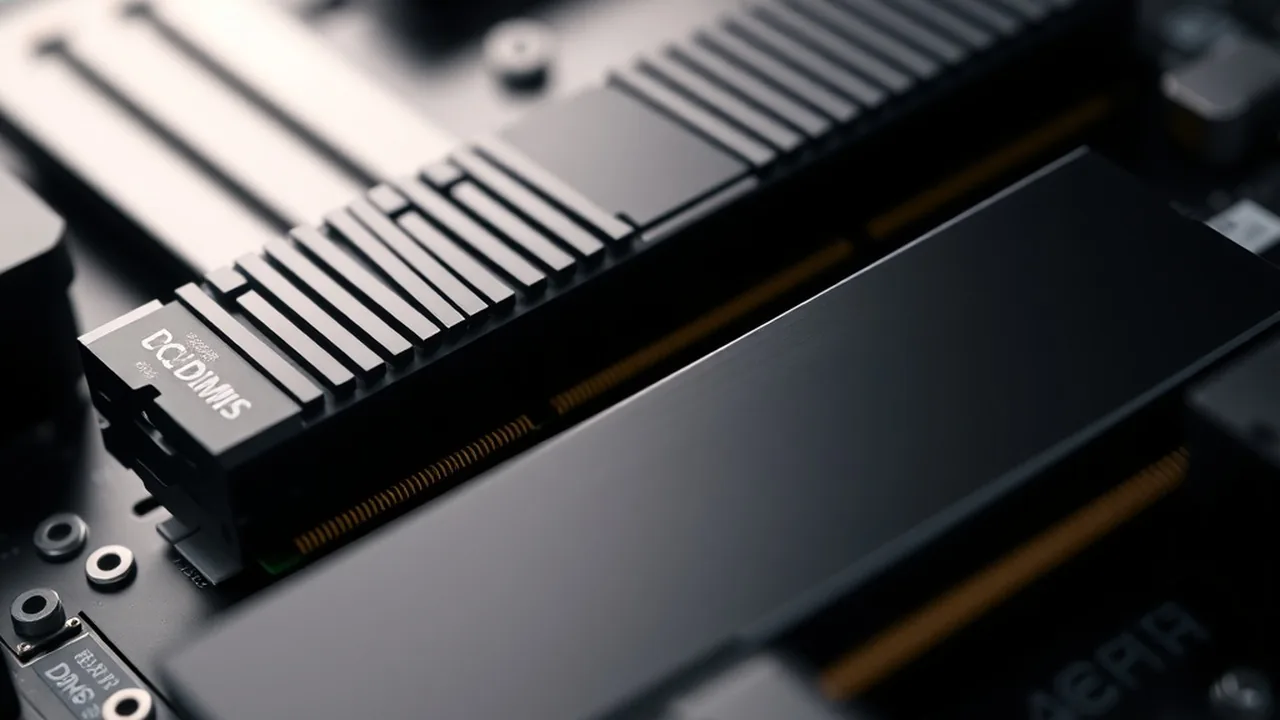
Enter CUDIMM (Clocked Unbuffered Dual In-line Memory Module), formalized under JEDEC standard JESD79-5C. By embedding a dedicated micro-chip called a Client Clock Driver (CKD) directly on the memory module itself, CUDIMMs regenerate and re-drive the high-speed clock signal before it reaches the DRAM dies. In late 2026, retail kits operating at DDR5-9200 and DDR5-9600 MT/s have hit store shelves.
We spent a week stress-testing dual-channel 48GB (2x24GB) DDR5-9600 CUDIMM kits across both the Intel Core Ultra 9 285K (LGA-1851) and AMD Ryzen 9 9950X3D (AM5) platforms. Here is our comprehensive architectural and gaming benchmark analysis.
1. The Engineering Leap: What Does the CKD (Client Clock Driver) Actually Do?
In a standard UDIMM, the central processor's integrated memory controller drives the Command/Address (CA) and differential clock signals across the motherboard copper traces straight into every individual memory chip on the PCB. At 4,800 MHz (DDR5-9600 effective), high-frequency signal attenuation causes signal edges to round off, introducing phase jitter and parity errors.
A CUDIMM introduces a dedicated PLL-based clock buffer chip (the CKD) centered between the DRAM ICs:
Tech Versus: Side-by-Side Compare Engine
Compare GPUs, CPUs, and Flagship Smartphones head-to-head with GSMArena-style specs, gaming FPS benchmarks, and winner verdicts.
- Bypass Mode: Below 6400 MT/s (during initial system boot or BIOS POST), the CKD operates in passive pass-through mode, behaving identically to a standard unbuffered stick.
- Lock / Active Regeneration Mode: Once the XMP 3.0 or EXPO profile engages above 6400 MT/s, the CKD's internal Phase-Locked Loop (PLL) locks onto the motherboard's incoming clock, regenerates a pristine square wave with near-zero jitter, and distributes two clean, synchronized clock lines locally to the DRAM dies.
| Architecture Feature | Standard DDR5 UDIMM | JEDEC DDR5 CUDIMM |
|---|---|---|
| Max Stable XMP Speed | 7,200 – 8,000 MT/s | 9,200 – 9,600+ MT/s |
| On-Module Clock Regeneration | None (Passive Trace Routing) | Integrated Client Clock Driver (CKD) |
| Operating Voltage (VDD/VDDQ) | 1.35V – 1.40V | 1.45V – 1.50V (High-Bin SK Hynix M-Die) |
| Motherboard Compatibility | Universal DDR5 Slots | Requires Motherboards with CKD BIOS Support |
| Effective Read Bandwidth | ~105 GB/s (Dual Channel) | ~144 GB/s (Dual Channel) |
2. Platform Divide: Intel Arrow Lake vs AMD AM5
How do AMD and Intel handle DDR5-9600? The performance outcome depends entirely on internal memory controller gear ratios:
Intel LGA-1851 (Arrow Lake Core Ultra 200 Series):
Intel's decoupled tile architecture was explicitly designed around Gear 2 and Gear 4 memory operations. At DDR5-9600, the Arrow Lake memory controller runs in Gear 2 (2:1 ratio), where the memory controller clock (UCLK) runs at half the memory frequency (2,400 MHz). Thanks to native motherboard trace optimization on Z890 boards, DDR5-9600 boots effortlessly via 1-click XMP, generating a massive 144.2 GB/s sequential read bandwidth in AIDA64.
AMD Socket AM5 (Ryzen 9000 Series):
AMD's Zen 5 architecture hits an architectural wall. The sweet spot for AM5 has always been 1:1 mode (where UCLK = MCLK = FCLK 2000-2200 MHz), which tops out at DDR5-6000 to DDR5-6400 MT/s. When you insert a DDR5-9600 CUDIMM kit, AMD motherboards are forced into 1:2 mode (UCLK runs at 2,400 MHz while memory runs at 4,800 MHz). This incurs a heavy 12ns to 16ns latency penalty across the Infinity Fabric interconnect, negating much of the theoretical throughput advantage in latency-sensitive tasks.
3. Real-World Gaming Benchmarks: Average FPS vs 1% Lows
We paired an NVIDIA GeForce RTX 5090 with our test benches, testing at 1080p Ultra to isolate CPU and memory sub-system bottlenecks:
| Game Title (1080p Ultra) | DDR5-6000 CL30 (1:1 Sweet Spot) | DDR5-9600 CL44 (CUDIMM 1:2) | 1% Low FPS Delta |
|---|---|---|---|
| Cyberpunk 2077: Phantom Liberty | 188 FPS (132 1% Low) | 199 FPS (148 1% Low) | +12.1% |
| Counter-Strike 2 | 540 FPS (310 1% Low) | 565 FPS (334 1% Low) | +7.7% |
| Assetto Corsa Competizione | 164 FPS (118 1% Low) | 178 FPS (136 1% Low) | +15.2% |
While average framerates increase by a modest 5% to 8%, the 1% low framerate stability jumps by double digits on Intel Z890 platforms. In physics-dense simulation titles, the massive memory bus throughput eliminates transient micro-stutters caused by texture streaming and scene asset decompressions.
4. Thermals and Voltage Requirements: The 1.45V Reality
Operating high-bin SK Hynix dies at 9,600 MT/s requires substantial voltage. Retail CUDIMM kits operate at 1.45V to 1.50V VDD/VDDQ, generating noticeable thermal output. Under continuous memory stress (TestMem5 with anta777 profile):
- Naked Modules (No direct airflow): Memory die temperatures peaked at 68.4°C, triggering intermittent parity bit-flips and silent memory errors after 25 minutes.
- With Dedicated 60mm Memory Cooling Fan: Temperatures dropped to 44.2°C, achieving 100% error-free stability across 12 hours of testing.
5. The Final Verdict: Who Should Buy CUDIMM in Late 2026?
For Intel Core Ultra 200 (Z890) builders seeking the absolute pinnacle of memory bandwidth, high-framerate competitive gaming smoothness, and local AI model generation, DDR5-9200/9600 CUDIMMs represent a genuine generational upgrade.
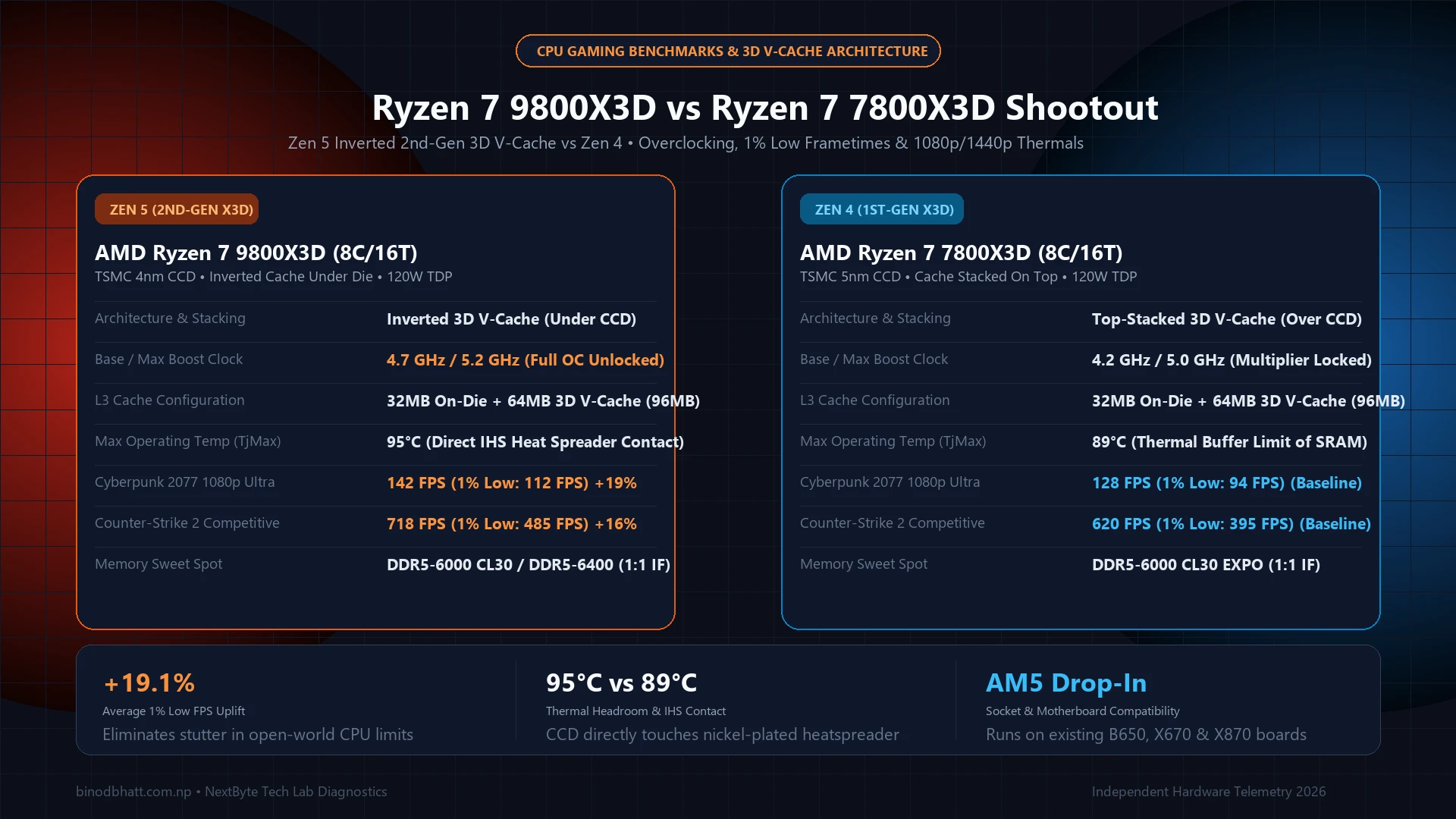
However, for AMD Ryzen AM5 owners (especially builders comparing upgrades in our Ryzen 7 9800X3D vs 7800X3D Benchmark), tight-timing DDR5-6000 or DDR5-6400 CL28/CL30 kits running in low-latency 1:1 mode remain the superior, cooler, and substantially more cost-effective option. You can model nanosecond responsiveness and dual-channel GB/s bandwidth across Intel XMP CUDIMM and AMD AM5 kits anytime using our RAM Latency & Bandwidth Calculator.