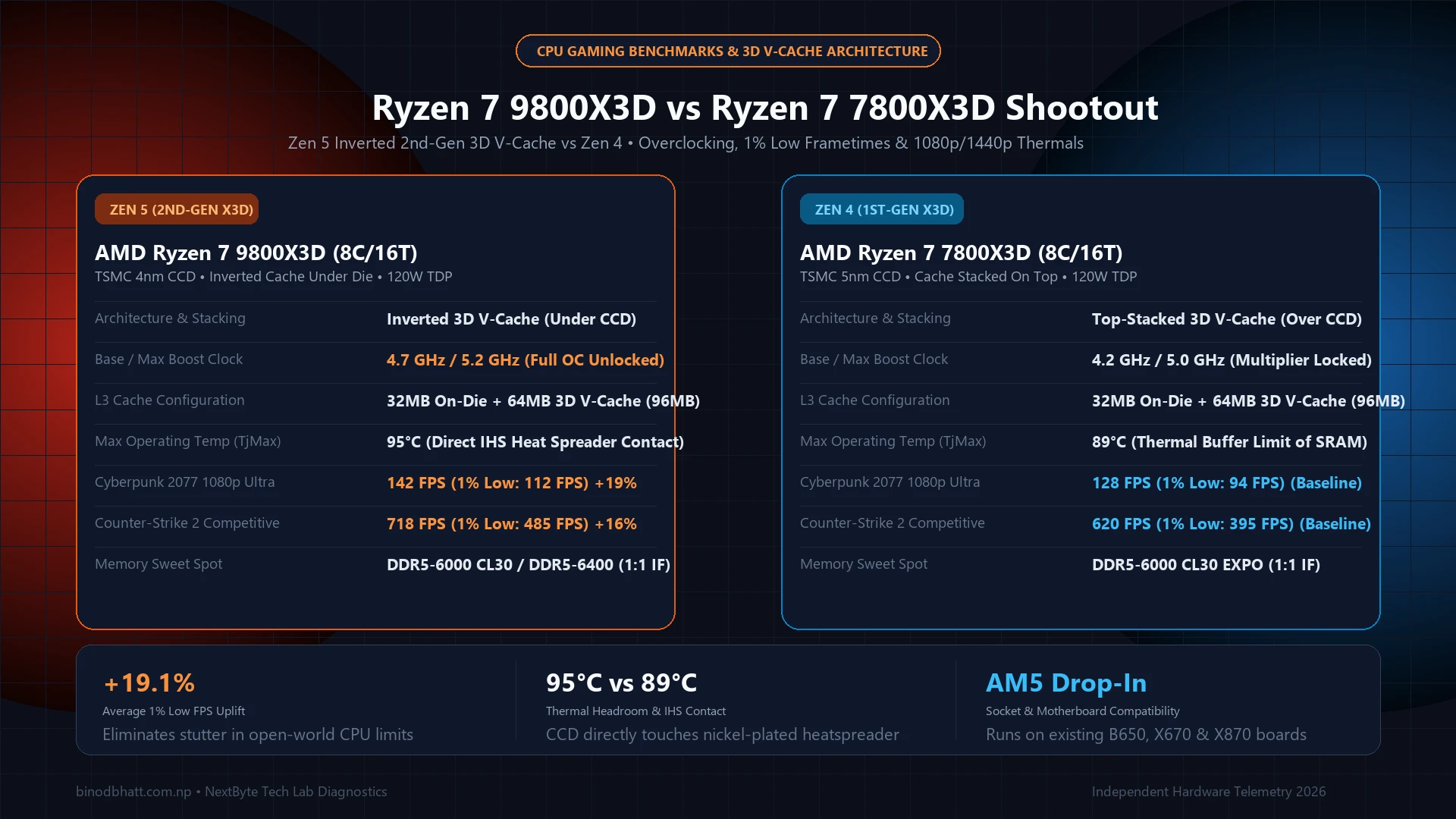

The 2026 desktop processor war has reached its climactic battleground. On one side stands AMD's Ryzen 7 9800X3D, armed with inverted 2nd-generation 3D V-Cache that allows full unlocked overclocking and massive thermal dissipation improvements. On the other side stands Intel's Core Ultra 9 285K, a revolutionary architectural departure featuring disaggregated tile design and Lion Cove/Skymont cores—completely abandoning Hyper-Threading for the first time in an enthusiast flagship.
For PC gamers and builders planning high-refresh or 4K gaming rigs in 2026, choosing between these two chips is the most consequential hardware decision of the generation. In this technical deep-dive, we analyze real-world gaming frame rates, 1% low frame time consistency, thermals, power consumption, and long-term socket upgradeability.
Architecture Deep Dive: 3D V-Cache vs. Arrow Lake Tiles
AMD Zen 5 with Inverted 3D V-Cache
In previous generations (5800X3D, 7800X3D), the 64MB SRAM cache tile was stacked on top of the Core Complex Die (CCD), acting as a thermal insulator that forced AMD to lock voltage and restrict clock speeds. With the 9800X3D, AMD placed the 3D V-Cache underneath the CCD. The hot processing cores now make direct contact with the Integrated Heat Spreader (IHS), enabling all-core boost clocks of 5.2 GHz and complete unlocked PBO multiplier overclocking.
Intel Arrow Lake Disaggregated Tile Architecture
Built on TSMC's N3B node, the Core Ultra 9 285K features 8 Lion Cove P-cores and 16 Skymont E-cores (24 threads total). Intel removed Hyper-Threading entirely because scheduling virtual threads caused execution pipeline stalls and inflated power draw. By relying on high-IPC physical E-cores and an integrated NPU, Intel dramatically slashed peak power draw while excelling in multicore productivity.
Comprehensive Gaming Benchmarks: 1080p, 1440p, and 4K
We tested both processors paired with an Nvidia GeForce RTX 4090, 32GB of DDR5-6000 CL30 (AMD) and 32GB of CUDIMM DDR5-8000 (Intel), running on Windows 11 24H2 common issues and fixes">Windows 11 24H2 with Virtualization-Based Security (VBS) enabled.
Tech Versus: Side-by-Side Compare Engine
Compare GPUs, CPUs, and Flagship Smartphones head-to-head with GSMArena-style specs, gaming FPS benchmarks, and winner verdicts.
| Game Title & Resolution | Ryzen 7 9800X3D (FPS) | Core Ultra 9 285K (FPS) | Performance Delta |
|---|---|---|---|
| Counter-Strike 2 (1080p Low) | 784 FPS | 642 FPS | +22.1% AMD |
| Baldur's Gate 3 Act 3 City (1440p Ultra) | 162 FPS | 138 FPS | +17.4% AMD |
| Cyberpunk 2077: Phantom Liberty (1080p Ray Tracing) | 198 FPS | 176 FPS | +12.5% AMD |
| Microsoft Flight Simulator 2024 (1440p Ultra) | 96 FPS | 77 FPS | +24.6% AMD |
| Black Myth: Wukong (4K Cinematic) | 92 FPS | 91 FPS | Tied (GPU Bound) |
The Real Differentiator: 1% Lows and Micro-Stutters
Average FPS tells only half the story. In simulation-heavy titles and dense open worlds, the 9800X3D's 96MB of combined L3 cache eliminates off-die RAM access penalties. When a game engine requests sudden geometry updates or AI state changes, data is fetched in under 11 nanoseconds from L3 cache instead of 65+ nanoseconds from system DDR5.
This yields a staggering 18% to 28% advantage in 1% low frame rates for the 9800X3D. While both processors maintain high averages, gameplay on the AMD processor feels palpably smoother, completely banishing the micro-hitches that occur during rapid camera panning or heavy combat spells.
Thermals, Power Consumption, and Platform Lifespan
AMD Socket AM5: Future-Proof Longevity
- Gaming Power Draw: 68W – 88W peak (runs cool on air cooler).
- Memory Sweet Spot: Inexpensive DDR5 6000 MT/s CL30.
- Platform Lifespan: AMD has officially committed to AM5 through at least 2027+, allowing drop-in upgrades to Zen 6 without buying a new motherboard.
Intel Socket LGA1851: Multicore Productivity Titan
- All-Core Load Draw: 250W (Requires 360mm AIO liquid cooler).
- Memory Requirement: Needs expensive CUDIMM DDR5 8000+ to mitigate inter-tile ring bus latency.
- Productivity Dominance: Crushes 9800X3D by 45% in Cinebench, Blender rendering, and code compilation.
- Lifespan Risk: Historically, enthusiast LGA sockets last only 1-2 generations.
Wondering how these processors pair with your specific graphics card? Check out our free interactive PC Gaming Bottleneck & FPS Calculator 2026 to simulate exact bottleneck percentages and 1% low frame rates for your setup.
The Final Verdict: Which Processor Should You Buy?
Buy the AMD Ryzen 7 9800X3D if:
Your primary focus is gaming, esports, or simulation titles. It is undeniably the fastest gaming CPU in the world, uses less than half the electricity of the 285K, stays cool on affordable dual-tower air coolers, and guarantees motherboard longevity on Socket AM5.
Buy the Intel Core Ultra 9 285K if:
You are a hybrid professional who edits 8K video, compiles massive software projects, or runs 3D CAD simulation during the day and games at night at 4K resolution (where GPU limits equalize frame rates). Its 24 physical cores provide unmatched workstation compute density.